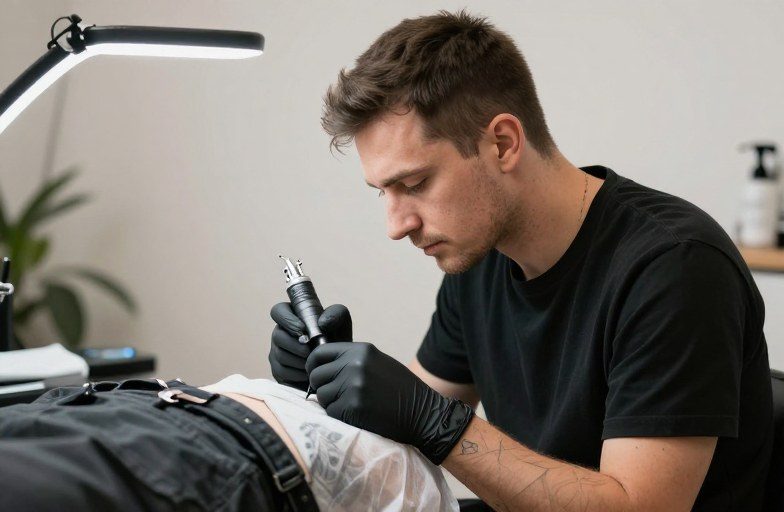
Geometric tattoos build images from straight lines, perfect circles, repeating polygons, and mathematically derived patterns. The style ranges from standalone sacred geometry, think Flower of Life, Metatron’s Cube, or platonic solids, to geometric framing around animals, skulls, or botanical subjects. Some artists specialize in dotwork shading within geometric boundaries; others work almost exclusively in clean black lines with no fill. The precision required separates competent geometric work from genuinely excellent pieces. A line that’s off by a millimeter throws off an entire mandala. This guide covers what to look for when searching for a geometric tattoo artist near you, how the technical demands affect your experience, and what happens to these designs as the years pass.
Who It Suits
Skin Type and Placement Considerations
Geometric tattoos favor flat, stable surfaces. The chest, back, outer upper arms, and thighs hold lines with minimal distortion. Knees, elbows, ribs, and stomach shift too much with movement and breathing; circles become ovals, straight lines warp. Fair to medium skin with minimal freckling or sun damage shows the sharpest contrast. Darker skin tones absolutely work for geometric tattoos, but the artist needs experience adjusting line weight, thicker lines read more clearly, and excessive fine detail can muddy together. Ask to see healed photos on skin similar to yours, not just fresh work.
Design Preferences That Fit
People drawn to this style usually want visual order, symmetry, or symbolic structure. Geometric sleeves read as architectural armor. Small behind-the-ear pieces offer discreet personal markers. Large back pieces function as meditation tools, you can literally get lost tracing the pattern. The style doesn’t suit those wanting organic flow, spontaneous energy, or photorealism. It’s controlled, calculated, sometimes cold. That restraint is exactly the appeal for some, a dealbreaker for others.
- Best placements: chest panels, upper back, outer biceps, thighs, calves
- Challenging but possible: forearms (watch for twist distortion), ribs (accept some breathing movement)
- Generally avoid: inner biceps (soft tissue shifts), stomach (weight fluctuation), hands and feet (high fade, line spread)
Choosing the Right Artist
What to Look For in a Portfolio
When you search “geometric tattoo artist near me,” you’ll find generalists who dabble and specialists who live in this lane. Distinguish them by portfolio depth. Look for healed work, not just fresh photos, redness and swelling hide imperfections. Check for consistent line weight throughout large pieces, perfect circle closure, and parallel lines that don’t converge or drift. Dotwork should show even density, not clumping or bare patches. An artist with fifty geometric pieces in their portfolio understands how ink settles into skin differently than someone with five.
Questions Worth Asking
Stencils for geometric work are unforgiving. Ask whether they draw custom geometry or adapt existing patterns. Custom work costs more but fits your body’s proportions. Ask about their stencil process, do they freehand adjustments or stick rigidly to the printout? Rigid stencils on curved surfaces create distortion. A skilled geometric artist adjusts for body contour. Also ask about machine setup: single needle work versus three-round liner versus mag shaders. Each produces different edge quality.
- Request healed photos from 6+ months prior
- Ask about their experience with your specific design type (mandala, dotwork, sacred geometry, geometric realism)
- Discuss whether they’ll adapt the design for your specific body placement
Linework & Technique
Needle Configurations and Their Effects
Geometric tattoos demand specific technical choices. Single needle (1RL) produces hair-fine lines that look crisp initially but blur faster as ink disperses under skin. Three-round liner (3RL) offers the most common balance, fine enough for detail, substantial enough to hold. For bold outlines and heavy black fill, artists reach for seven or nine-round liners, or even small magnum shaders. Dotwork typically uses single needle or three-round liner, building tone through density rather than shading. The needle depth matters enormously here; too shallow and lines fall out during healing, too deep and blowout creates fuzzy edges that destroy precision.
Symmetry and Body Contours
Perfect symmetry on paper becomes distorted on a curved body. Experienced geometric artists account for this, sometimes intentionally asymmetrizing the stencil so it reads symmetrically to the viewer. Large back pieces viewed from behind require different proportions than chest pieces seen from the front. The artist must understand viewing angle and adjust accordingly. This is where searching broadly for “geometric tattoo artist near me” falls short, you need someone who understands your specific placement, not just the style generally.
Cost & Sessions
Geometric work runs expensive for good reason. The prep time alone, drawing, adjusting, stenciling, re-stenciling, often exceeds the actual tattooing for small pieces. Large mandalas or sacred geometry sleeves require full-day or multi-day sessions. Pricing structures vary: some artists charge hourly, others by piece, others by day rate. Expect day rates for substantial geometric work to run higher than typical tattoo day rates because of the mental concentration required. A full geometric sleeve typically needs 4-8 full days depending on complexity, coverage density, and your pain tolerance affecting session length.
- Small geometric pieces (palm-sized): often 2-4 hours
- Medium panels (half chest, upper back): typically one long day or two shorter sessions
- Full sleeves or large back pieces: multiple full-day sessions, sometimes months apart
Budget for touch-ups. Even excellent geometric work often needs minor line reinforcement after healing, included in the original price by reputable artists.
Aftercare Notes
Healing Specifics for Line-Heavy Work
Geometric tattoos with heavy black fill or dense dotwork create more skin trauma than light linework. The scabbing tends to be thicker, the peeling more dramatic. Follow your artist’s specific instructions over generic advice, but generally: keep it clean, keep it slightly moist with recommended ointment, don’t pick at scabs that form along lines. Picking pulls ink out of precisely placed lines, disastrous for geometric work where placement accuracy defines the piece. Loose, breathable clothing prevents fabric from sticking and pulling at healing skin.
Protecting Precision Long-Term
UV exposure degrades black ink faster than you’d expect. A geometric tattoo left unprotected in sun for five years shows noticeable graying and line spread. Apply SPF 50+ when the tattoo will be exposed, reapply every two hours. This matters more for geometric work than many styles because the crisp edge definition is the entire aesthetic. Moisturizing daily maintains skin elasticity, preventing the fine lines from cracking or distorting as skin ages.
How It Ages
Short-Term Changes (1-3 Years)
Fresh geometric tattoos look almost digital, too perfect, almost printed. Within months, the ink settles, lines soften slightly, and the piece gains organic warmth. This is normal and often looks better, less sterile. Fine single-needle lines may blur together if placed too close. Lines that looked distinct at 1mm apart might read as a single thick line after healing. This is why experienced geometric artists space elements with aging in mind, not just fresh appearance.
Long-Term Evolution (10+ Years)
Black ink slowly disperses under skin. Sharp corners round slightly. Perfect circles become slightly imperfect. The overall structure remains readable if the original line weight was appropriate and placement was smart. Large, bold geometric pieces age significantly better than delicate fine-line geometry. Dotwork tends to hold well because the pattern relies on density rather than individual dot precision, one dot fading barely shifts the overall tone. Solid black fill lightens to charcoal gray, which can actually enhance three-dimensional geometric illusions.
Touch-ups every 5-10 years keep geometric work sharp, but many collectors prefer the softened, lived-in quality. The choice is personal, not a failure of the original work.
Final Word
Finding the right geometric tattoo artist near you means looking past proximity to proof of precision. The style’s beauty lives in its exactness, and exactness demands technical mastery, patient preparation, and honest communication about how your specific skin and placement will affect the outcome. Take time reviewing portfolios, ask technical questions without fear of sounding particular, and commit to the aftercare that preserves what the artist built. A well-executed geometric tattoo holds its power for decades, not because it ignores aging, but because it was designed with aging in mind from the first stencil line.
Frequently Asked Questions
How do I tell if a geometric tattoo artist actually specializes in this style?
Check whether geometric work dominates their portfolio or appears as occasional pieces among many styles. A specialist will show healed large-scale geometric work, not just fresh small pieces, and can discuss specific technical choices like needle grouping and stencil adaptation for body curves.
Can geometric tattoos cover up older tattoos or scars?
Geometric patterns can strategically incorporate scars by designing around them, but covering existing dark tattoos is challenging because the style relies on negative space and precise lines. Light scar tissue sometimes takes ink unpredictably; consult the artist in person for realistic assessment.
Why do geometric tattoos sometimes look distorted in photos versus real life?
Camera lenses distort at close range, especially wide-angle phone lenses used for tattoo photos. Curved body surfaces also create optical distortion from certain angles. The true test is viewing the piece straight-on from a normal distance, which is how the artist designed it to be seen.
Is dotwork within geometric tattoos more painful than line work?
Dotwork typically involves more needle contact points over the same area, which many people experience as a different sensation, more abrasive, less piercing, rather than clearly more or less painful. Session length matters more than technique; long dotwork sessions often feel more draining due to cumulative irritation.