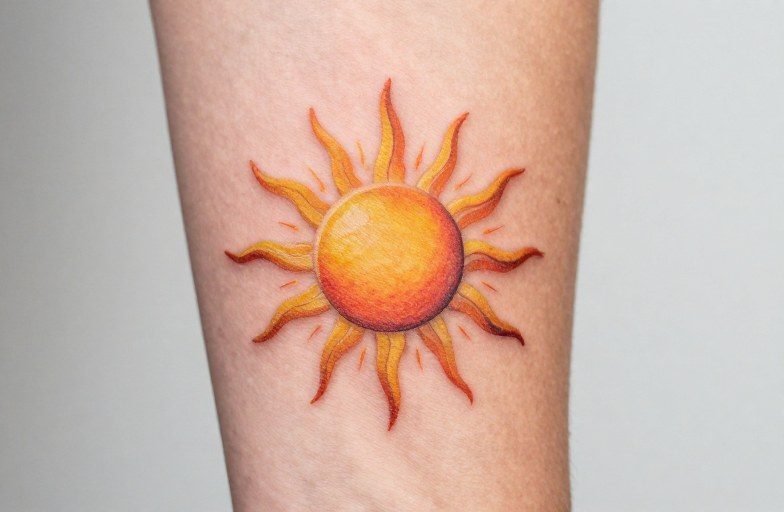
Sunshine tattoos carry an immediate, universal appeal. The motif works as a small flash piece behind the ear or as a full back-piece solar scene with planets and rays. What separates a good sunshine tattoo from a forgettable one is usually the handling of the rays, how they taper, whether they carry weight, and how the design accounts for the way yellow and orange pigments fade over time. This guide breaks down the practical decisions that shape how sunshine ink actually looks on skin five, ten, or twenty years down the line.
Trending Variations
The sunshine motif has shifted hard toward two camps in recent years: the ultra-minimal and the densely detailed. Both have their own technical demands and aging profiles.
Minimal Line Work
A simple circle with radiating straight lines, sometimes called a “sun icon”, takes fifteen to forty minutes depending on line count. The appeal is obvious: clean, readable from a distance, easy to place almost anywhere. The risk is blowout. Thin lines, especially on inner forearms or fingers where skin moves constantly, can spread into fuzz within two to three years. Ask your artist about going slightly heavier than you think you want, or accepting that a touch-up will be part of the lifecycle. Single-needle work looks delicate but ages poorly on high-friction areas.
Neo-Traditional and Illustrative Solar Scenes
On the other end, artists are building full compositions around anthropomorphic suns with faces, melting clocks, or celestial maps. These pieces rely on saturated oranges, deep reds, and heavy black outlines to create readable contrast. The black holds; the warm tones do not. Expect oranges to soften toward a peach or skin-tone within five to seven years, especially on areas with regular sun exposure. A strong black framework keeps the design legible even after color shift.
- Dotwork mandala suns: geometric precision, slower to execute, holds well on flat planes like thighs or upper back
- Black-and-gray solar rays: skips color concerns entirely, emphasizes texture and negative space
- Watercolor washes behind a solid sun: high initial impact, unpredictable long-term settling
For First-Timers
Sunshine designs offer a forgiving entry point if you choose the right execution. The circular core gives artists a natural focal point to build around, and the radiating structure helps the eye read the tattoo even if healing goes imperfectly.
What to Ask For
Request a stencil preview with the rays extended to their full length. Short, stubby rays often look fine on paper but cramped on curved skin. A first tattoo should also avoid heavy color packing in sensitive spots, if you want a yellow sun, consider keeping it small and on a meatier area like the outer thigh or upper arm. Yellow pigment sits higher in the skin than black and can feel more abrasive during the session.
What to Avoid
Skip finger placement for your first piece. Sun icons there blur fast, and the small canvas forces compression that loses the ray detail. White ink highlights, often pitched as “making the sun pop,” frequently yellow or disappear entirely within two years. If your artist pushes white as a primary element, push back or seek a second opinion.
Size & Scale
The sunshine motif scales surprisingly well, but each size tier demands different technical choices.
Under two inches, you are essentially doing a symbol. The circle must be large enough to hold ink without the edges breaking down into a blob. Rays at this scale should be limited, six to eight works better than twenty tiny spikes. At three to five inches, you can introduce facial features, gradient shifts, or secondary elements like clouds or birds. Beyond six inches, the sun becomes an environment rather than an object, and you will need background treatment to avoid the “sticker” effect where a floating symbol looks disconnected from the body’s flow.
Scale also dictates session length and cost in predictable ways. A two-inch linework sun might run one hour and $150-250. A six-inch illustrative piece with full color could demand three to four hours and stretch toward $600-900 depending on your region and artist’s rate. Budget for the work, not just the design.
Best Placements
Where sunshine tattoos live on the body changes how the rays read and how the ink survives.
Flat and Broad Surfaces
The upper back between the shoulder blades, the outer thigh, and the center of the chest offer the most stable canvas for symmetrical sun designs. Skin stretches less here over time, and the flat plane lets rays extend evenly without distortion from muscle movement. These spots also heal relatively simply, no constant bending or fabric rubbing against the fresh work.
Curved and Mobile Areas
Shoulder caps naturally suit the circular sun form, but the curve compresses lower rays and stretches upper ones. A skilled artist will account for this in the stencil, elongating certain rays so they read as balanced when the arm hangs naturally. The ribs and stomach move constantly with breathing; suns here blur faster and hurt more during the session. Ankle and wrist placement works for small icons but accepts faster degradation as part of the trade-off.
- Behind the ear: trendy, small, high visibility, but expect touch-ups
- Inner bicep: soft skin, moderate pain, good for medium-sized pieces with personal significance
- Top of foot: high fade zone, only for committed collectors who accept maintenance
How to Personalize It
The sunshine template invites modification without losing recognizability. The core moves, ray count, ray style, and central figure, each offer entry points for individual distinction.
Ray count carries loaded associations: eight rays often read as compass or cardinal directions, twelve as zodiac or hours, irregular counts as more organic or naturalistic. Jagged, lightning-style rays feel aggressive; soft, wavy rays read gentle or nostalgic. Straight geometric lines land modern and graphic.
The center holds equal opportunity. A solid circle keeps it abstract. A face, smiling, indifferent, or scowling, draws from folk traditions across multiple cultures, often linked to tarot imagery or early printed almanacs. Some trace the “sun with face” motif to 16th-century European woodcuts, though similar forms appear independently in Mesoamerican and East Asian art. Replacing the face with a personal symbol, a pet’s silhouette, a significant number, a small landscape, anchors the generic motif to specific memory without requiring text.
Color shifts personalization too. A strictly black sun reads as lunar or eclipse-like. Warm traditional palettes lean nostalgic. Unexpected cool tones, blue center, green rays, create deliberate cognitive dissonance that some collectors pursue deliberately.
Matching & Pairing Ideas
Sunshine tattoos pair naturally with lunar or celestial partners, but the execution matters more than the concept.
Split Designs
Two people carrying halves of a sun-and-moon composition, or one person wearing both on separate limbs, requires planning for how the pieces face. Rays that extend toward the moon on a shared chest piece should not point outward awkwardly when separated onto two bodies. The gap between elements, negative space, needs as much design attention as the ink itself.
Complementary Collections
Within a larger sleeve or body of work, a sun can serve as the warm anchor among cooler pieces. A collector with ocean-themed work might add a sun as the light source above the waterline. Botanical collectors use sunshine as the implied energy behind floral growth. The key is consistent stylistic treatment: a black-and-gray sun among color work looks like an afterthought unless the contrast is intentional and balanced elsewhere.
Sequential tattoos, sunrise to noon to sunset across multiple sessions, can track personal timelines or relationships. The progression gives each piece context it would lack alone.
What to Remember
Sunshine tattoos succeed or fail on details that only reveal themselves after the initial glow fades. Prioritize the structural elements: clean black outlines or strong black shading that will hold form as color drifts. Yellows and oranges will warm and soften; plan for that rather than fighting it. Placement determines maintenance burden more than design complexity does. A simple sun on a foot needs more future attention than a complex one on a thigh.
Choose an artist whose portfolio shows healed work, not just fresh photos. The bright, saturated sun you see on Instagram day-of will not be the sun you live with. Ask to see pieces six months or a year old, especially any with yellow or orange dominant. The best sunshine tattoo is the one that still reads as intentional and balanced after the first wave of color settling passes.
Bring reference, but bring flexibility. The sun is among the most tattooed images across cultures and centuries; your version gains value not from novelty but from precision of execution and honesty of placement. A small, perfectly rendered sun where you can see it daily outperforms a grand concept poorly situated every time.
Frequently Asked Questions
Do yellow and orange inks fade faster than other colors in sunshine tattoos?
Yes. Warm tones sit higher in the dermis and break down more quickly under UV exposure. Expect noticeable softening within five to seven years on regularly exposed skin. Strong black outlines or shading preserve the design’s structure even as color shifts.
How much should I expect to pay for a medium-sized sunshine tattoo with color?
Most experienced artists charge $150-250 per hour. A three-to-four-inch piece with solid color packing typically runs two to three hours, so budget $300-750 depending on your region and the artist’s rate. Highly detailed or large-scale work scales up from there.
Can a sunshine tattoo be covered up or modified later if I want something different?
The circular center and radiating lines make suns moderately challenging to cover. Dense blackwork or a larger design incorporating the existing shape works best. Laser fading before cover-up is often recommended for colorful or heavily saturated pieces.
Is a sun with a face culturally appropriative or problematic?
The anthropomorphic sun appears across many unrelated traditions, from European almanac prints to Mesoamerican stone carvings. Context and specific stylistic copying matter more than the general motif. Avoid directly reproducing identifiable sacred imagery from cultures you have no connection to; consult your artist if a specific reference concerns you.