An angel tattoo most commonly signals protection, memory, or spiritual presence, though the specific meaning depends heavily on design choices. A weeping angel with a sword reads differently than a small cherub on a shoulder. The symbolism ranges from guardian and messenger to fallen rebel, giving this imagery unusual flexibility across belief systems and personal narratives.
Mythology & Folklore
From Messenger to Warrior
Angels in tattoo imagery pull from several overlapping traditions. Biblical seraphim and cherubim, winged beings surrounding divine presence, evolved in art from abstract flames to recognizable human forms with feathered wings. Archangels Michael and Gabriel, often depicted with swords or trumpets, represent protection and announcement respectively. These figures carry inherent authority; they’re not passive decorations but active intermediaries.
Medieval folklore expanded the repertoire significantly. Guardian angels assigned to individuals at birth became a widespread concept, particularly in Catholic tradition. This idea translates directly into tattoo culture: a guardian angel often represents someone watching over the wearer or a protective presence the wearer embodies for others. The visual language matters here, swords suggest active defense, while open hands or downward gazes imply watchful care.
The Fallen Angel Archetype
Lucifer’s rebellion and subsequent fall generated a separate visual tradition: the broken or dark angel. In tattooing, this typically manifests as tattered wings, bound hands, or downward-facing figures. The symbolism often reads as personal struggle, loss of faith, or defiance against unjust authority rather than literal Satanic affiliation. Milton’s Paradise Lost significantly shaped this interpretation in Western culture, making the fallen angel a figure of tragic complexity rather than simple evil.
Best Placements
Size Determines Viability
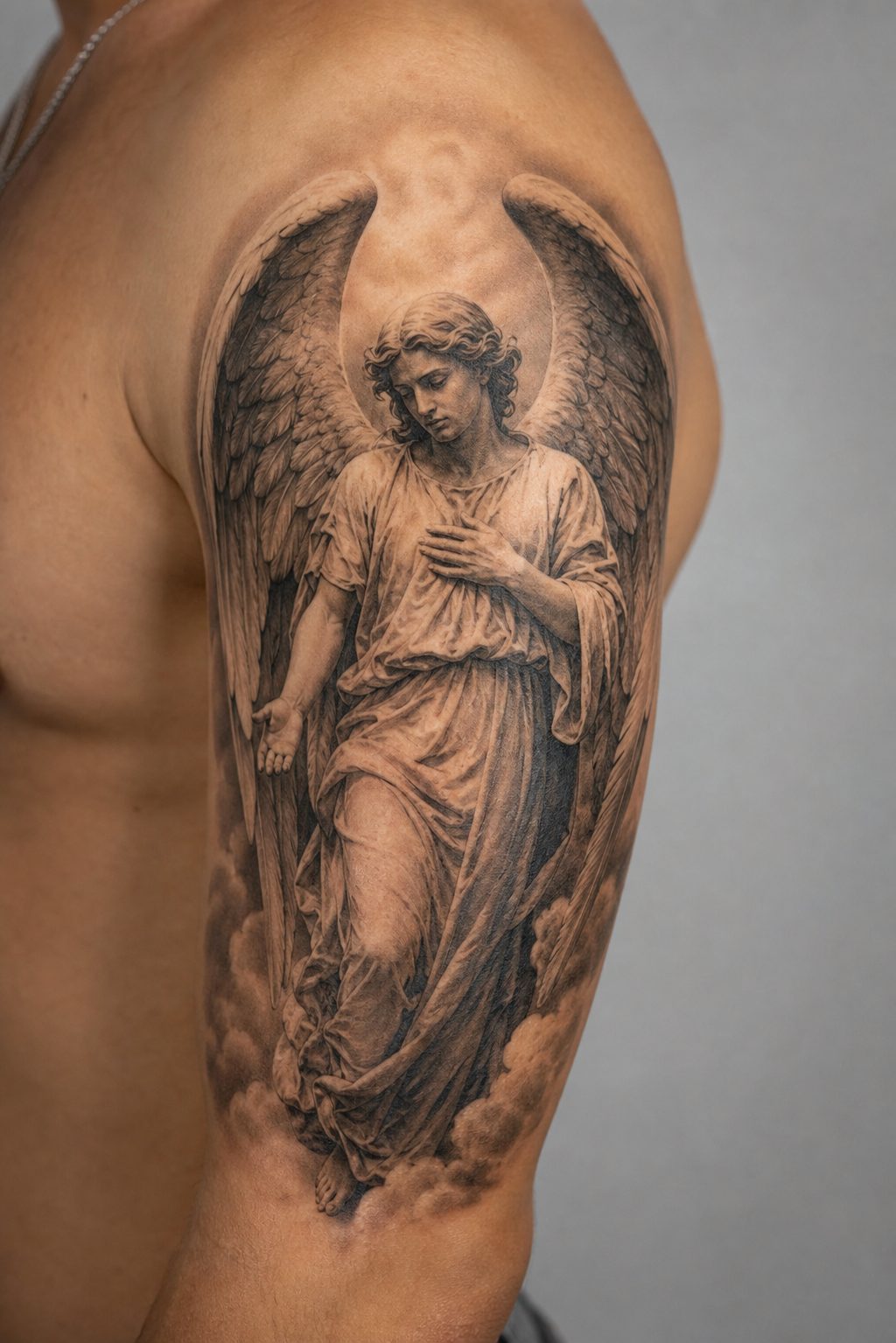
Angel tattoos demand space for the wings to read correctly. A full back piece allows for proper wing span with individual feather detail, this is where the design achieves its most dramatic impact. The upper back, spanning shoulder to shoulder, works for medium-sized pieces where wings fold partially or extend beyond the frame. Forearms and calves accommodate smaller guardian figures, though wings often wrap around the limb rather than spreading.
- Chest/pectorals: Popular for heart-protector symbolism; wings can frame the sternum or extend toward shoulders
- Upper arm/shoulder cap: Natural wing placement following deltoid curve; allows for 3/4 sleeve integration
- Ribcage: Vertical compositions work well here, though healing is notoriously difficult due to movement and friction
- Thigh: Underrated placement with excellent canvas space; less sun exposure preserves detail longer
How Placement Affects Aging
Wings with fine feather lines blur faster on high-movement areas like wrists and ankles. The ribcage stretches and compresses with breathing, gradually distorting vertical figures. For longevity, broader wing structures with bold line weights outperform delicate single-needle featherwork on most body locations. The upper back and outer thighs offer the most stable surfaces for detailed angel compositions that need to hold up ten to fifteen years.
Who Chooses This Tattoo
Memorial angels dominate requests following family deaths, particularly parents mourning children, where the guardian aspect becomes literal and urgent. Military personnel and first responders sometimes select archangel Michael specifically, drawn to his warrior-protector identity. People with religious upbringings who’ve drifted from practice often choose angels over crosses, finding the imagery less doctrinally specific while maintaining spiritual vocabulary.
The fallen angel subset attracts a different demographic: those processing addiction recovery, incarceration, or profound personal betrayal. It’s less about aesthetic edge and more about identifying with a figure punished for rebellion, seeking redemption, or existing in ambiguous moral territory. These clients typically arrive with specific literary or artistic references rather than requesting generic “dark angel” flash.
History & Cultural Roots
Religious Art Precedents
Angel imagery in tattooing descends directly from centuries of Christian iconography. Byzantine mosaics established the frontal, rigid angel with symmetrical wings. Renaissance painting introduced foreshortening, emotional expression, and dynamic poses that modern tattoo artists still reference. The Pre-Raphaelite movement’s pale, melancholic angels influenced the ethereal, almost consumptive aesthetic popular in 1990s tattooing, think soft gray shading, downturned eyes, and flowing hair without hard edges.
Secular Adaptation
The 20th century saw progressive secularization of angel imagery. Victorian mourning jewelry featured angel silhouettes without explicit religious context. Hollywood cemented the “guardian angel” as a narrative device in film noir and fantasy. By the 1970s, biker and military tattoo culture had absorbed angels alongside eagles and skulls as American masculine symbols of protection and death. This hybrid heritage means contemporary angel tattoos can operate in entirely secular registers without losing visual coherence.
Personal & Modern Meanings
Contemporary wearers layer meanings that would puzzle historical believers. An angel with a parent’s handwriting incorporated into the banner. A figure with a specific breed of dog at its feet. Wings composed of meaningful objects, musical instruments, tools, flowers, rather than feathers. These personalizations function as private visual systems, readable only to those who know the reference.
Some modern interpretations explicitly reject protection in favor of presence. The angel as witness rather than guardian. The angel as memory that doesn’t fade. The angel as question rather than answer. This shift reflects broader cultural movement away from certainty toward ambiguity in spiritual expression.
Design Tips & Pairings
Line Work Versus Shading
Traditional American angel tattoos rely on bold black outlines with limited color, red, blue, yellow, green in classic Sailor Jerry proportions. These age well and maintain readability at smaller sizes. Photorealistic angel portraits require extensive gray wash shading and typically need refreshment within five to seven years as the subtle gradations blur together. Neo-traditional approaches split the difference: bold lines with expanded color palettes and more anatomical detail than old-school work without full photorealism.
Common Pairings
- Clouds and rays: Classic background establishing heavenly context; works best with traditional or religious styling
- Names and dates: Memorial applications; script placement requires careful integration so text doesn’t compete with the figure
- Roses or lilies: Roses for love and grief, lilies for restored innocence; both provide color contrast to skin-toned angel figures
- Clocks or hourglasses: Mortality pairing; effective but risks cliché without personalized modification
- Scripture or poetry excerpts: Requires legible font choice and sufficient size; tiny text blurs into illegibility
Color choices carry practical weight. Extensive white ink in wings and halos yellows unpredictably on many skin tones and often requires reworking. Skin-tone angels without outline risk becoming invisible as surrounding skin tans or ages. A competent artist will discuss these limitations during consultation rather than simply executing the reference image.
Final Thoughts
Angel tattoos persist because the figure accommodates genuine emotional weight without demanding specific religious commitment. The same image can mourn a death, celebrate a birth, mark survival, or simply acknowledge beauty in a tradition the wearer doesn’t personally claim. What separates meaningful angel tattoos from generic ones is usually specificity, particular poses, particular faces, particular deviations from standard iconography that signal personal investment rather than convenient symbolism.
The technical execution matters enormously. Wings that don’t anatomically connect to the figure, eyes that don’t track properly, hands that look like afterthoughts, these errors destroy the gravity the image attempts. Angel tattoos require artists comfortable with human anatomy, drapery, and the difficult foreshortening of extended wings. Not every portfolio with one decent angel example can consistently deliver the composition. Look for repeated success with the specific style you want, whether that’s classical, traditional, illustrative, or realistic.
Healing considerations are standard but worth noting for large back pieces: sleeping position becomes complicated, and the temptation to pick at peeling wing edges runs high. Plan the timing around your life rather than rushing for an occasion. A well-executed angel tattoo, properly healed, occupies a rare space in body art, immediately readable to strangers, privately significant to the wearer, technically demanding enough to reward genuine artistic skill.
Frequently Asked Questions
Do angel tattoos have to be religious?
No. Many people choose angels for memorial purposes, protective symbolism, or aesthetic appreciation without any religious practice. The imagery has secular usage stretching back centuries.
How much does a detailed angel back piece typically cost?
Large, detailed angel tattoos require multiple sessions and significant artist skill. Expect to invest substantially in both time and money, with full back pieces often spanning months of appointments.
What’s the difference between a cherub and a seraphim tattoo?
Cherubs are depicted as childlike figures, often associated with love and innocence. Seraphim are fiery, six-winged beings representing divine presence, dramatically different visually and symbolically.
Why do some angel tattoos look blurry after a few years?
Fine feather details and extensive white ink are prone to spreading and discoloration over time. Bold outlines and strategic shading placement hold definition much longer on most skin types.