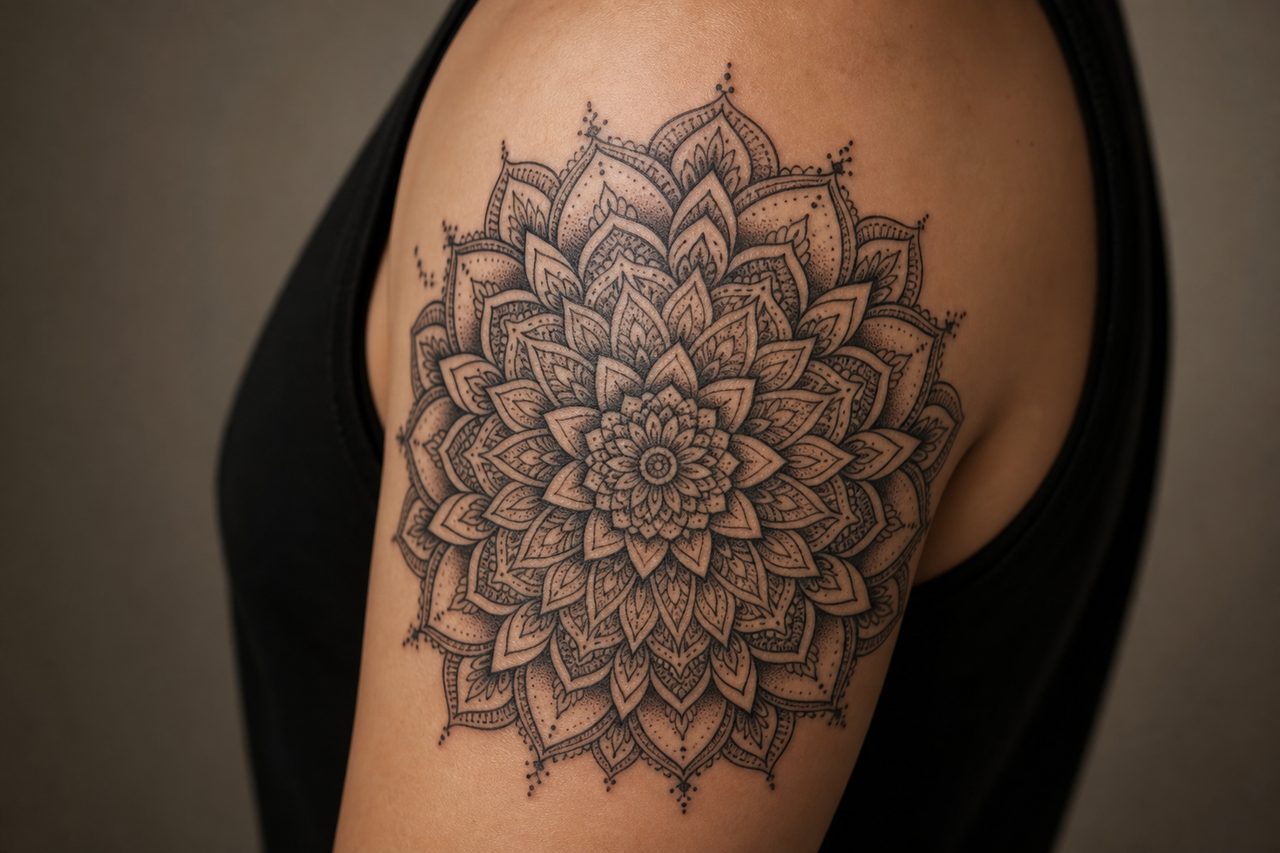
A mandala tattoo represents the universe in miniature, a geometric diagram with a fixed center and radiating symmetry. The word itself comes from Sanskrit, roughly “circle” or “container of essence,” and the design traditionally maps cosmic order onto a flat plane. In tattoo form, that translates to balance, wholeness, and the idea that the self sits at the center of an interconnected whole. How elaborate that gets depends on the wearer and the artist, but the core symbolism stays consistent: a boundary, a center, and a path between them.
Symbolism & Core Meaning
At its simplest, a mandala is a circle containing a square, containing a circle, containing whatever the designer wants at the heart. That nesting structure matters. The outer ring acts as a boundary, protection, containment, the edge of the known world. Moving inward, the geometry gets denser, pulling focus toward the center. Psychologically, that mirrors meditation: attention gathered from the periphery to a single point.
Common symbolic elements include:
- Lotus petals: purity emerging from murky conditions, common in Buddhist and Hindu mandalas
- Cardinal directions: the four gates or doors in a square mandala, representing access to deeper states
- Fire walls or vajra rings: protective barriers between sacred and mundane space
- Bindu (dot center): the seed point, origin point, or concentrated consciousness
The mandala’s symmetry also carries weight. Bilateral balance reads as stability to the eye. In a tattoo, that means the design holds up even as the body moves, unlike a portrait that might distort with shoulder rotation, a mandala’s radial structure maintains its integrity from multiple angles.
Personal vs. Traditional Interpretation
Some people choose mandalas purely for visual impact, drawn to the intricate linework and meditative quality. Others come with specific spiritual intent, using the tattoo as a permanent focal point for mindfulness or as a marker of personal transformation. Neither approach invalidates the other. The design’s flexibility is part of its longevity as a tattoo motif.
Religious & Spiritual Angles
Mandalas function differently across traditions, and tattoo wearers often mix or ignore these distinctions entirely. Knowing the origins helps avoid unintentional disrespect.
Buddhist & Hindu Sources
In Vajrayana Buddhism, sand mandalas are ritually constructed then destroyed, teaching impermanence. A permanent tattoo obviously inverts that practice, which has sparked genuine debate among practitioners. Some Tibetan teachers have explicitly discouraged mandala tattoos for this reason. In Hindu tantra, yantras (geometric diagrams similar to mandalas) serve as tools for deity meditation, with specific shapes corresponding to specific gods. A Saraswati yantra and a Kali yantra carry different energies and shouldn’t be treated as interchangeable decoration.
That said, many Western tattoo collectors approach mandalas as generalized spiritual geometry rather than specific religious commitment. The key is awareness: if you’re drawn to a particular traditional form, research whether it carries obligations you’re not prepared to honor.
Modern & Secular Adaptations
Contemporary mandala tattoos frequently abandon religious specificity entirely. Artists combine geometric precision with organic elements, flowers, animals, celestial bodies, creating hybrid forms that borrow the mandala’s structure without claiming its traditional function. Jungian psychology also popularized the mandala as a symbol of individuation and psychological integration, giving non-religious wearers a framework for personal meaning.
Color vs. Black and Grey
This choice fundamentally changes how the tattoo ages and what it communicates.
Black and grey mandalas emphasize line weight and negative space. The design reads as architectural, timeless, slightly austere. Fine dotwork and stippled gradients create depth without color. These tattoos age well, black ink holds its value longer than most pigments, and the high contrast between solid black and skin tone keeps the geometry legible even as lines soften slightly over decades.
Color mandalas often reference specific traditions: saffron and maroon for Tibetan Buddhist forms, particular deity colors in Hindu yantras, or simply personal preference. Watercolor-style mandalas have trended heavily, but approach with caution, the technique relies on diffuse color bleeding that can blur faster than hard-edged linework. If you want color that lasts, ask for saturated pigments with defined borders, not atmospheric washes.
One practical note: color mandalas require more sessions and more expense. The geometric precision demands steady handwork, and filling large areas with consistent saturation takes time. Budget accordingly, and don’t rush an artist who works methodically.
Similar & Related Symbols
Mandalas get confused with or substituted for several related forms. Understanding the distinctions helps you communicate with your artist and know what you’re actually getting.
Yantras are strictly Hindu, usually more angular, and tied to specific deities or intentions. They lack the organic, circular flowering typical of Buddhist mandalas. Rangoli are temporary floor designs from Indian domestic practice, not tattoo material. Celtic knotwork shares the interlaced quality but operates on different symbolic logic, eternal return and lineage rather than cosmic mapping. Sacred geometry (Flower of Life, Metatron’s Cube) overlaps visually but derives from different traditions and carries different associations.
Some tattoos deliberately fuse these: a mandala structure with Celtic knot borders, or yantra geometry with Buddhist lotus petals. These hybrids work when intentional, read as muddled when accidental.
History & Cultural Roots
The mandala form is often linked to ancient Indian religious art, with some of the earliest surviving examples found in Buddhist cave paintings dating to the first millennium CE. The practice spread through Central Asia along trade routes, adapting to local aesthetics, Tibetan thangkas, Japanese esoteric Buddhist diagrams, Southeast Asian temple floor plans.
Its adoption into Western tattoo culture accelerated through the 1990s and 2000s alongside interest in Eastern spirituality and geometric abstraction. The rise of single-needle and fine-line tattooing gave artists the technical capacity to reproduce mandala-level detail at smaller scales. Instagram amplified visibility, creating feedback loops where popular designs spawned variations. What began as ritual art became accessible aesthetic vocabulary.
That trajectory isn’t neutral. The commercialization of mandala imagery has drawn criticism from practitioners of source traditions, particularly when sacred forms appear on merchandise or bodies without contextual understanding. If you’re considering a mandala tattoo, this history isn’t just background, it’s part of what you’re choosing to participate in.
Best Placements
Mandala geometry rewards certain locations and fights others.
Round or flat surfaces: the sternum, upper back between shoulder blades, center of the thigh. These preserve the circle’s integrity without the distortion that comes from wrapping around a cylinder.
Secondary locations: forearms, calves, shoulders. These work if the design adapts to the curve, often becoming partial mandalas, or incorporating the limb’s natural flow into the composition.
Challenging: ribs, sides of the torso, anywhere skin stretches significantly with breathing or movement. The precision that makes mandalas striking becomes hard to maintain across unstable surfaces.
Size matters. A mandala under three inches loses its internal detail; over eight inches on a small body can dominate disproportionately. The sternum placement, currently popular, carries specific considerations: painful, slow to heal due to movement and sweat, and the shape should complement rather than fight the natural breast contour.
Before You Decide
A mandala tattoo commits you to maintenance. The fine lines and dotwork that define the form blur faster than bold traditional work. Plan for touch-ups, protect from sun, and choose an artist whose geometric portfolio demonstrates actual precision, not just enthusiasm.
Consider also whether you want traditional or contemporary, religious or secular, color or blackwork. These aren’t afterthoughts; they determine the entire design approach. The best mandala tattoos result from specific decisions, not defaulting to whatever image search returns first.
Finally, sit with the image. The mandala’s traditional function involves prolonged contemplation. A tattoo version deserves at least a fraction of that deliberation before needles touch skin.
Frequently Asked Questions
Can a mandala tattoo be disrespectful if I’m not Buddhist or Hindu?
It depends on the specific design. Generic geometric mandalas rarely offend. Sacred forms like specific deity yantras or Tibetan sand mandala reproductions can be problematic without cultural connection. Research your chosen image, and when uncertain, consult with practitioners from the source tradition or choose a more secular adaptation.
How well do fine-line mandalas hold up over time?
They require more maintenance than bold work. Single-needle lines and delicate dotwork can soften significantly within 5-10 years, especially on sun-exposed skin. Plan for periodic touch-ups, and prioritize artists who build in structural redundancy, slightly heavier key lines that preserve the form even as finer details age.
What’s the difference between a mandala and sacred geometry tattoo?
Mandalas are specifically circular, center-focused diagrams with established religious histories, primarily Buddhist and Hindu. Sacred geometry is a broader category including linear forms like the Flower of Life, Metatron’s Cube, and Platonic solids, with roots in multiple traditions including Greek mathematics and occultism. They overlap visually but carry different symbolic weight.
Is sternum placement as painful as people say for mandalas?
Yes, generally. The sternum has thin skin directly over bone with little muscle padding, and the vibration from tattooing ribs adds a distinctive discomfort. Mandalas require sustained precision work in this sensitive zone, making the session feel longer than comparable work on fleshier areas. Pain tolerance varies, but budget for breaks and don’t expect to chat casually through the process.