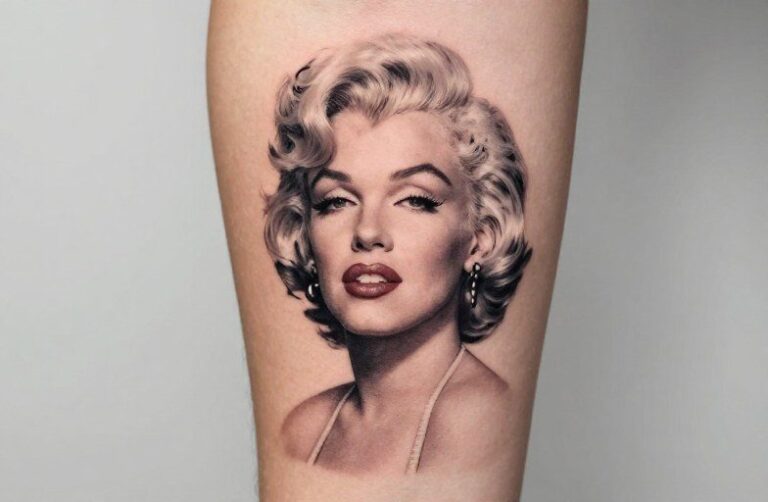
Animal tattoos are everywhere for a reason. The human eye reads animal shapes instantly, predator or prey, fur or scales, motion or stillness. That instant recognition makes them powerful visual shorthand, but it also means bad animal tattoos look extra bad. A wonky wolf silhouette reads as “broken dog” in under a second. What follows covers what actually works in real skin: placements that respect anatomy, styles that age cleanly, and the specific decisions that separate a tattoo you’ll keep from one you’ll cover.
Best Placements
Animals have direction. They face left or right, they crawl upward or downward. That built-in movement makes placement more consequential than with abstract or symmetrical designs.
Flowing with the Body
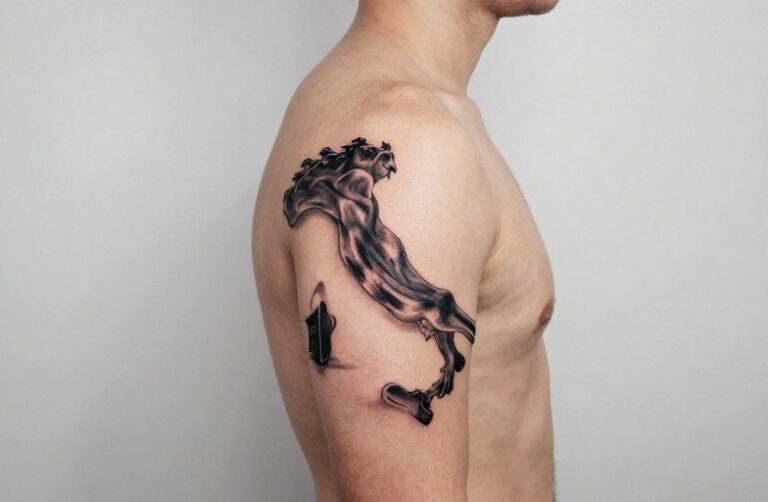
Snakes and fish thrive along the forearm, calf, or side of the torso where the body already moves in an S-curve. A snake wrapping a bicep follows the muscle’s natural spiral. Birds in flight work exceptionally well across the upper chest or shoulder blade, where the wing span can open across the natural width of the bone structure. Predators in stalking poses, low-slung cats, hunting wolves, suit the thigh or outer calf, where the horizontal ground plane of the limb gives them something to prowl across.
Related reading: animal tattoo designs | Hawaiian tattoo designs meanings | geometric tattoo artist near me | fine line geometric tattoo
Some placements fight the design. A large animal head facing straight forward on a flat stomach panel looks pinned there, disconnected from the body’s architecture. Turn that same head in profile, let it follow the oblique line from hip to rib, and it belongs to the body.
Small but Legible
Finger and hand animals are notoriously difficult. The space is small, the skin is thick and mobile, and the detail that makes a species recognizable, muzzle length, ear set, tail carriage, vanishes quickly. If you want something small, choose animals with extreme silhouettes: a giraffe’s neck and horns, a flamingo’s single leg and curved neck, a bat’s wing spread. These read at thumbnail size. Generic four-legged animals do not.
Behind the ear and along the jawline can work for small animals in profile, but expect faster fading. That skin moves constantly and sees sun.
Color Choices
Animal tattoos fall into two color camps: naturalistic and symbolic. Both have specific technical demands.
Naturalistic Palettes
Realistic animal color requires understanding how tattoo pigment differs from fur or feather. Tiger orange is not one orange; it’s a base of warm yellow-orange with darker burnt orange striping and near-black line work. Without that value range, aged tiger tattoos flatten into a pumpkin-colored blob. Realistic bird feathers need the iridescent blues and greens built from white highlights over blue and teal layers, not a single flat color pass.
White ink in animal eyes and highlights is a specific choice with tradeoffs. Fresh white pops dramatically. Aged white yellows or disappears entirely into lighter skin tones. Some artists build “white” from negative space and very pale skin tones instead, which lasts but reads differently.
Symbolic and Restricted Palettes
Black-only animal tattoos, whether solid black silhouettes, dotwork, or black-and-grey realism, age more predictably than color. A solid black raven silhouette on a forearm will look essentially the same in fifteen years. A full-color macaw on the same spot will need significant refresh.
Single-color symbolic choices carry weight: red for foxes in Japanese tradition, gold for tigers in Korean folk art, blue for certain protective animals in Mediterranean tattooing often linked to sailor histories. These work best when the color choice is intentional and complete, not a half-measure.
Matching and Pairing Ideas
Multiple animals in one composition or across a pair of bodies require more planning than single pieces.
Predator and Prey Balance
Predator-prey pairings need visual balance, not just narrative. A wolf and deer composition works when both carry equivalent visual weight, similar size, comparable detail level, balanced placement. A hyper-detailed wolf looming over a tiny simplified deer reads as dominance of style, not nature.
Matching Tattoos for Two People
Matching tattoos across two people work best with species that naturally pair: wolves as pack animals, swans that mate for life, oxen in traditional Korean wedding imagery. The design should function as a complete image when together and as a coherent standalone when apart. Two halves of one face only work when pressed together; separate, each looks broken. Two swans facing each other, necks forming a heart, each complete on its own body, is a better solution.
Zodiac or spirit animal pairings often suffer from mismatched visual languages. A realistic Taurus bull paired with a geometric Aquarius water-bearer looks like two different tattoos. Commit to one style for both.
How to Personalize It
The most successful animal tattoos carry specific information beyond species identification.
Specific Individuals
Pet portraits are the obvious path, but the technical demands are severe. A generic dog tattoo can borrow from reference photos and artistic convention. A portrait of your actual dog requires the specific asymmetries that make that animal recognizable: the slight ear tilt, the scar above the eye, the particular way the fur grows whorled on the chest. Work from multiple high-resolution photos in consistent lighting. One snapshot with flash distortion will yield a distorted tattoo.
For memorial pieces, consider whether you want the animal at a specific age or as an idealized version. Both are valid; they’re different tattoos.
Habitat and Context
An animal without environment floats. Adding specific habitat, not generic nature background but the actual red rock of Sedona for a desert tortoise, the particular moss and bark pattern of Pacific Northwest old growth for a spotted owl, grounds the design in place and memory. This requires the artist to work from reference, not repertoire.
Negative space can create habitat. A deer formed from the gap between pine branches, a bear silhouette filled with mountain contour lines, integrates animal and place without cluttering the design.
Popular Styles
Style choice determines how the tattoo ages and what visual language it speaks.
Line Work and Illustrative
Single-line animal tattoos are technically demanding. One continuous line must carry all the information: species, pose, character. The best examples use line weight variation, thick for body mass, hairline for whiskers and fur texture. Without that variation, they age into uniform spaghetti. The style suits smaller scales and animals with flowing, continuous forms: cranes, snakes, certain fish.
Illustrative or etching style animal tattoos use crosshatching and stipple to build tone. These age well if the dot density is high enough; sparse stipple spreads and looks like skin texture, not intentional mark-making.
Realism and Neo-Traditional
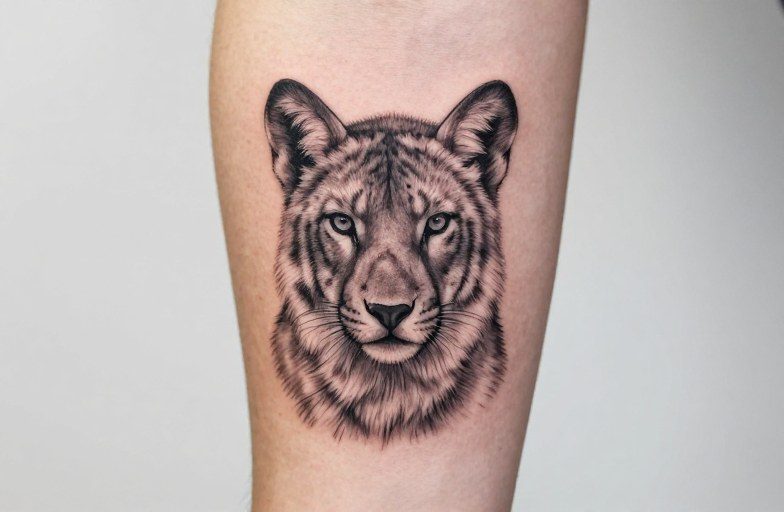
Realistic animal portraits require an artist who specializes in the form. The fur texture alone demands specific needle configurations and an understanding of how hair direction changes across the body. Realism also demands large scale; a photorealistic thumbnail-sized animal is technically impossible.
Neo-traditional animal designs use bold outlines, limited but saturated color palettes, and stylized proportions, often larger eyes, more pronounced expressions. The style is forgiving of aging because the bold lines hold and the simplified color shapes don’t depend on subtle gradation. Animals in this style carry personality more than accuracy.
Size and Scale
Animal tattoos have minimum effective sizes determined by biological detail.
- Faces and heads: Need about 3 inches minimum to include eyes, nose structure, and ear detail that reads as that species. Smaller becomes generic mammal.
- Full bodies: 4-6 inches for small animals like rabbits or cats, 8 or more inches for large animals with proportional limbs such as horses or standing bears.
- Patterned animals: Tigers, leopards, giraffes need enough scale for the pattern to read as pattern, not noise. A 2-inch leopard becomes a yellow cat with mud spots.
- Feather and fur detail: Each feather or tuft needs physical space. Dense fur texture at small scale becomes a blur; sparse, defined strokes work better small.
Large-scale animal back pieces or torso panels allow for environmental storytelling, but they also commit the entire canvas to one subject. The visual weight of a large predator across the upper back shapes how clothing sits and how the body reads in space. That’s the point, but it’s worth deciding consciously.
What to Remember
Animal tattoos succeed or fail on recognition and integration. The species must read instantly, which means respecting minimum sizes and choosing detail appropriate to the scale. The design must integrate with your body, not sit on top of it like a sticker, which means considering direction, flow, and how the animal moves through the space you give it.
Color choices are long-term commitments. Black and grey ages quietly; color demands maintenance and fades on its own schedule. If you choose color, build it in layers with value range, not flat washes that will disappear into uniform tone.
Personalization comes from specificity, not from adding more. A single accurate detail, the exact tilt of your dog’s ears, the particular rock formation where you saw that rattlesnake, carries more weight than a dozen generic symbols layered on top. Work with artists who draw from reference, not from memory, and who will tell you when your placement idea fights the design rather than flattering it.
The best animal tattoos look inevitable, as if that creature always lived on that part of your body and the artist merely revealed it. That effect is built, not accidental, through every decision about direction, scale, color, and style. Make those decisions deliberately, and the result will last.
Frequently Asked Questions
What is the minimum size for a recognizable animal portrait tattoo?
For faces and heads, about 3 inches is the practical minimum to include eyes, nose structure, and ear detail that reads as the specific species. Anything smaller tends to collapse into generic mammal. Full bodies need 4 to 6 inches for small animals like cats or rabbits, and 8 or more inches for large animals with proportional limbs such as horses or standing bears.
Do animal tattoos in color age worse than black and grey?
Yes, generally. Black-only animal tattoos, whether silhouettes, dotwork, or black-and-grey realism, age more predictably and fade less noticeably. Color tattoos require maintenance and will shift over time; specific pigments like orange and yellow are particularly prone to changing. That said, intentional color choices with proper value range can last well if you accept future refresh sessions.
Where on the body do animal tattoos work best?
Placement depends on the animal’s natural movement. Snakes and fish flow along S-curves like the forearm, calf, or torso side. Birds in flight suit the upper chest or shoulder blade where wing spans open across bone structure. Predators in stalking poses work on the thigh or outer calf where the horizontal limb gives them ground to prowl. Avoid flat frontal placements like the center stomach where the animal looks pinned rather than integrated.