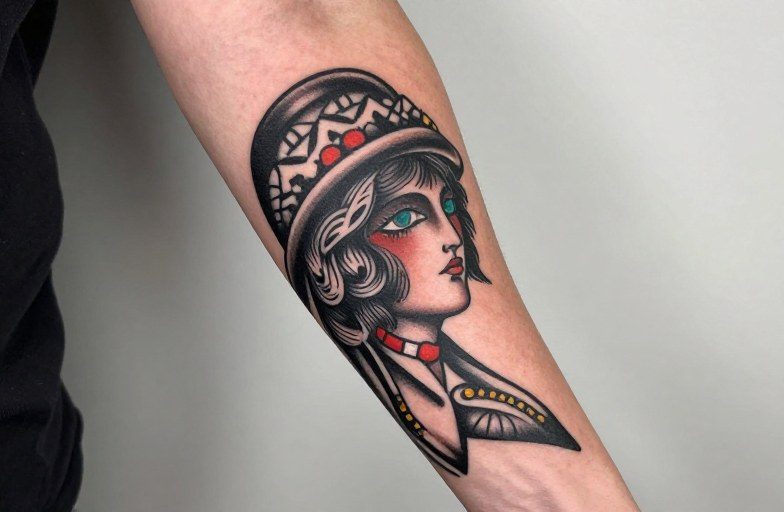
American traditional tattooing on the forearm means thick black outlines, saturated color fields, and recognizable imagery. Roses, eagles, snakes, anchors, pin-ups, and banners all find natural homes on one of the most visible placements on the body. The forearm’s flat planes and gradual taper from elbow to wrist suit the style’s need for bold, readable shapes that hold up through years of sun exposure and daily wear.
What Makes It Read as Traditional
The Visual Grammar
The rules are strict and immediately identifiable. Line weight stays heavy, usually achieved with round liner needle groupings for crisp, uniform strokes. Color sits in flat, unblended pools: flag red, navy blue, mustard yellow, forest green, and pitch black. Shading, when present, uses sparse black whip-shading or simple gradients rather than smooth gray-wash transitions. Negative space functions as a design element, not an afterthought.
Common forearm motifs include:
Related reading: American traditional forearm tattoos | trad forearm tattoo meaning | mens forearm meaning tattoo | small forearm tattoos male
- Swallows and sparrows, often paired or flying toward or away from the heart
- Snakes coiled through daggers or roses, exploiting the forearm’s length
- Anchor and rope combinations, frequently wrapping the wrist or elbow
- Pin-up figures in profile or three-quarter view, sized for the outer forearm’s broader surface
- Banners with lettering, curved to follow the natural arc of the muscle
- Panthers and tigers, their stripes and spots simplified for clarity at distance
Forearm-Specific Adaptations
The inner forearm’s thinner skin and proximity to veins demands slightly adjusted line weight. Artists often go a touch heavier to compensate for the area’s tendency to spread ink during healing. The outer forearm’s muscle movement means designs anchored near the wrist or elbow will shift slightly when the hand clenches; smart placement accounts for this distortion rather than fighting it.
Wrist and elbow transitions require particular care. A design that stops abruptly at the wrist bone looks stranded; one that flows into the hand or wraps slightly onto the wrist feels intentional. Similarly, elbow ditch pieces in traditional style need simplified centers because the skin there stretches and compresses dramatically, blurring detail over time.
Origins and Historical Context
Where the Style Took Shape
The style’s roots are often linked to late-19th and early-20th century American port cities, where tattooists like Samuel O’Reilly and later Bert Grimm, Sailor Jerry Collins, and others standardized a visual language drawn from maritime culture, circus banners, and military insignia. Some trace specific motifs to earlier European traditions, particularly British naval tattooing that crossed the Atlantic, but the cohesive American traditional aesthetic most likely crystallized between the 1920s and 1950s.
The forearm’s popularity as placement grew from practical visibility. Sailors needed tattoos that showed in short sleeves, and the location avoided the more painful rib and sternum areas. By the 1940s, a decorated forearm signaled membership in specific naval rates or wartime service. The style’s post-2000s resurgence, particularly in work worn by tattooers themselves, cemented the forearm as favored placement for bold, classic work.
Technical Foundations
Traditional linework relies on tight needle groupings in round configurations for crisp, uniform strokes. The forearm’s relatively flat surfaces allow consistent needle depth, though the wrist’s thinner skin requires lighter pressure. Artists working in authentic traditional style often avoid mag shaders for fills, preferring the slight texture of round shader or color packer work.
Speed matters. The hand moves quickly, depositing ink in confident single passes rather than building lines through multiple tentative strokes. This approach produces the slight wobble and human irregularity that distinguishes living traditional work from digital-looking neo-traditional or illustrative styles.
Color, Black, and Longevity
The Classic Palette
Traditional color theory is deliberately constrained. Pigment choices lean toward stable, time-tested formulations: reliable reds, cobalt blues, yellows, and carbon black. These colors were selected for longevity under sun exposure, a critical factor for the always-visible forearm. Faded American traditional work still reads clearly because the black outline carries the design even when color softens over time.
Black and Grey Interpretations
Black and grey traditional strips out color but maintains the same bold outlines and simplified forms. On the forearm, this approach ages well, avoiding the blue-green drift that some pigments undergo. The limitation is legibility: without color contrast, designs must rely more heavily on shape recognition and negative space. A black and grey snake on a black and grey background becomes mud; the same design with strategic skin breaks remains readable.
Some artists working in this mode use diluted pigment for subtle tonal variation, though purists argue this edges into illustrative territory. For collectors wanting longevity with minimal maintenance, black and grey traditional on the forearm offers practical advantages.
Modern Variations and Evolution
Neo-Traditional and Contemporary Hybrids
Contemporary artists have stretched the traditional framework while keeping its forearm-friendly boldness. Neo-traditional work introduces more complex color gradients, varied line weights, and illustrative detail, sometimes showing Japanese woodblock influences or Art Nouveau flourishes, while maintaining enough black outline to survive the placement. The forearm suits these hybrids because its visibility rewards the extra detail; a neo-traditional piece that might blur on a thigh or back often holds up here.
Subcultural Adaptations
Skate, punk, and metal communities have produced traditional-adjacent work with darker palettes, horror imagery, or pop culture references rendered in classic technical constraints. A traditional-format portrait of a horror character, or a reimagined sailor motif with contemporary symbolism, reads instantly as forearm-appropriate because the technical bones remain familiar. These variations succeed or fail based on whether the artist understands the underlying structure: outline weight, color saturation, and negative space that make traditional work durable.
Choosing the Right Artist
What to Look For in Portfolios
Examine healed photos, not fresh work. Traditional tattooing’s boldness makes it uniquely susceptible to the fresh photo bias: everything looks crisp before the skin settles. Ask to see pieces six months or older, particularly on forearms. Look for consistent line weight, color that has not muddied, and shapes that still read at thumbnail size. An artist’s flash sheets reveal their understanding of the style’s constraints: limited detail, strong silhouettes, self-contained compositions that do not rely on background elements.
Shop Culture and Specialization
Artists who primarily work in American traditional often operate in shops with explicit traditional focus, though this is not universal. The style demands specific equipment preferences. Some prefer coil machines for their punch and line saturation, though rotary users achieve comparable results with refined technique. More telling than machine choice is whether the artist draws daily in the idiom, maintaining the visual vocabulary through repetition. Someone who tattoos traditional once monthly among varied styles may execute adequately but rarely achieves the unconscious fluency that separates competent from compelling work.
Communication style matters too. Traditional tattooing has historical conventions about placement, orientation, and composition that experienced practitioners will explain rather than simply accept your preference. A swallow facing backward or a banner with illegible lettering betrays the style’s communicative function; good artists push back on choices that undermine the work’s readability.
What to Remember
The Visibility Question
The forearm announces itself. You will see this tattoo daily, and so will employers, family, strangers. American traditional work carries specific cultural associations: working-class pride, military service, rebellion, or simply aesthetic conservatism within tattoo culture itself. Consider whether these associations align with how you present yourself, not because any single meaning is fixed, but because visibility means interpretation is out of your control.
Pain and Practicality
The outer forearm rates moderate on most pain scales: muscle padding helps, though the radial nerve near the wrist can spike sharply. The inner forearm, especially near the ditch (the inner elbow crease), hurts more due to thin skin and nerve density. Plan sessions accordingly; a full outer forearm piece is manageable in one sitting, while wrapping onto the inner arm or elbow may require breaking into multiple appointments.
Healing demands attention on this placement. The forearm catches everything: desk edges, sunlight through car windows, shirt sleeves rubbing. You cannot easily hide it from yourself, which means resisting the urge to pick or over-moisturize requires more discipline than with a back or thigh piece.
Planning for the Long Term
Think about sleeve integration even if you are starting with one piece. A standalone traditional forearm tattoo should occupy its space completely, with background elements or sufficient skin breaks to prevent the floating effect. If you plan to build outward, discuss this with your artist; a piece designed as the center of a larger composition needs different spacing than one meant to stand alone forever.
The best forearm traditional work looks inevitable, as if it could not have been placed anywhere else. Choose based on healed results, respect the style’s constraints rather than fighting them, and understand that this placement leaves little room for error. Bold, simple, and technically excellent: that is the standard, and the forearm exposes anything less.
Frequently Asked Questions
How long does an American traditional forearm tattoo take to heal?
Surface healing usually takes two to three weeks, though full color settling and skin normalization can take two to three months. The outer forearm generally heals more easily than the inner forearm, which has thinner skin and more contact with clothing.
Can I get an American traditional forearm tattoo in black and grey?
Yes. Black and grey traditional maintains the bold outlines and simplified forms of the style while removing color. This approach often ages better on the forearm, avoiding pigment drift, though designs must rely more heavily on strong silhouettes and negative space to remain readable without color contrast.
How do I know if an artist is actually skilled in American traditional?
Ask to see healed photos, especially forearm pieces six months or older. Look for consistent line weight, color that has not muddied, and shapes that read clearly at small sizes. Examine their flash sheets for understanding of the style’s constraints: limited detail, strong silhouettes, and self-contained compositions. An artist who draws daily in the traditional idiom will show unconscious fluency that occasional practitioners lack.
Does American traditional work on the inner forearm?
Yes, though the thinner skin and proximity to veins requires adjusted technique. Artists often use slightly heavier line weight to compensate for ink spread during healing. The inner forearm also tends to hurt more and heal more slowly due to constant contact with clothing and surfaces.