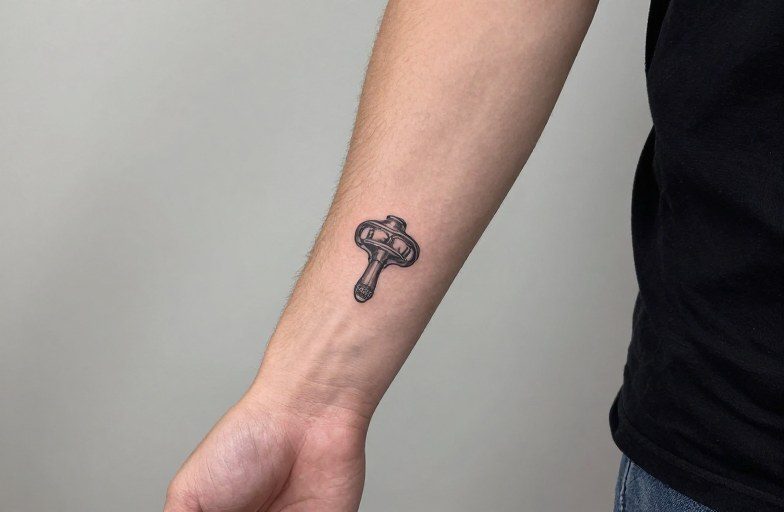
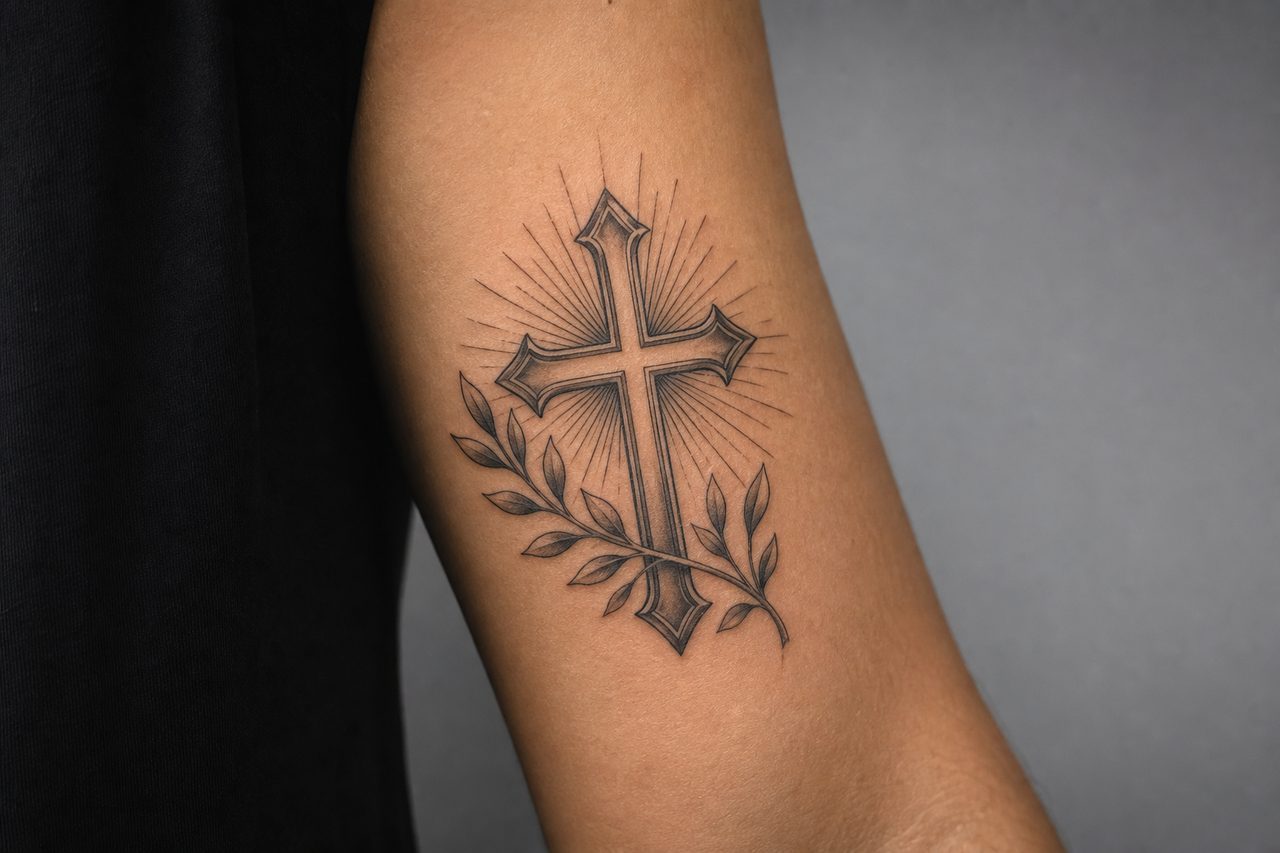
A Christian tattoo marks personal faith, commitment, or spiritual identity through recognizable religious imagery. The meaning depends heavily on the specific symbol chosen, a crucifix carries different weight than an ichthys fish or a verse reference. Most designs serve as permanent reminders of belief, milestones like baptism or recovery, or connection to a particular tradition within Christianity.
How It Ages on Skin
Christian imagery often relies on fine lines and high contrast, which determines how well it holds up over years. Understanding this helps you choose a design that stays legible rather than turning into a blurred suggestion of what it once was.
Line Work vs. Shaded Crosses
Simple black-line crosses age predictably. A single-needle outline cross on a forearm or shoulder tends to spread slightly, lines that start at 1mm may double in width over a decade. This actually suits some Gothic or rustic cross styles. Shaded crosses with soft gray washes blur faster; the subtle gradations that give a cross dimension tend to muddy together, especially on skin that sees sun regularly. Bold black tribal-style crosses with solid fill last longest but read as more decorative than devotional.
Text and Small Details
Scripture references and tiny lettering are the biggest aging risk. A verse reference like “John 3:16” in 8-point font along a wrist or ribcage may become unreadable within 5-7 years. Lettering needs minimum 10-point equivalent for longevity, and serif fonts hold crisper edges than flowing scripts. Greek or Hebrew text faces the same challenge, what looks elegant fresh often becomes illegible blobs. If you want scripture, consider larger placement or integrating text into bolder imagery rather than standalone fine lettering.
Common Variations & Styles
The visual language of Christian tattoos spans nearly two thousand years of art history, giving you substantial range beyond the basic cross.
- Crucifix: Corpus Christi figure attached, usually Catholic or Orthodox preference. Demands skilled figure work; poorly executed Christ figures become unintentionally grotesque as they age.
- Celtic cross: Ringed cross with knotwork. The interlace patterns blur with age but maintain recognizable structure longer than you’d expect due to the geometric repetition.
- Ichthys (fish): Minimalist, fast to tattoo, ages excellently. Often placed on ankle, wrist, or behind ear. Early Christian symbol predating the cross as common identifier.
- Alpha and Omega: Greek letters with or without flame or crown motifs. Works well as companion pieces, matching tattoos, or bookending a larger design.
- Dove with olive branch: Peace and Holy Spirit reference. Requires careful color choice, white ink yellows; soft gray or muted blue holds better.
- Stained glass style: Color-heavy, technically demanding. Saturated blues and reds fade to purple-brown haze without strong black outlines to contain them.
Denominational Distinctions
Catholic collectors often favor Marian imagery, rosary beads wrapped as bracelets or anklets, or saint portraits. These require significant skin real estate and commitment to maintenance. Protestant designs lean toward scripture text, plain crosses, or Reformation symbols like the five solas. Orthodox traditions sometimes use icon-style portraits with specific halos and gold backgrounds, technically challenging and usually requiring an artist familiar with the visual canon.
Religious & Spiritual Angles
The symbolism operates on multiple registers simultaneously, which partly explains the enduring popularity.
For many, the tattoo functions as permanent prayer, a way to carry spiritual focus into daily visual awareness. A cross on the wrist or forearm sits where the wearer sees it during work, conflict, or temptation. This differs from jewelry in its irrevocability; you can’t remove it when faith wavers, which is precisely the point for some.
Others use Christian imagery to mark transformation narratives, recovery from addiction, surviving violence, or recommitment after estrangement from church community. The tattoo becomes boundary-marker rather than simple decoration, signifying a before and after.
There’s also the historical thread of tattooing as Christian practice. Coptic Christians in Egypt have long tattooed crosses on inner wrists as identity markers; some trace this to persecution under Roman rule, though documentary evidence is sparse before the medieval period. Ethiopian Orthodox traditions similarly use tattooing. These lineages matter to collectors seeking connection beyond contemporary American evangelical tattoo culture.
Who Chooses This Tattoo
Demographics here are broader than stereotype suggests. Yes, you’ll find plenty of post-conversion young adults getting first tattoos after religious commitment. But Christian imagery also attracts:
- Lapsed believers returning to tradition, using tattoo as irreversible step back in
- Theological students and clergy wanting visible faith markers that spark conversation
- People with Christian family heritage who aren’t personally devout but honor ancestry
- Collectors of religious art across traditions, treating Christian imagery as aesthetic category among others
Military and first responder communities show strong Christian tattoo prevalence, often combining crosses with unit insignia or memorial dates. The combination can create tension if the cross dominates the commemorative function or vice versa, worth discussing with your artist if you’re blending purposes.
Design Tips & Pairings
Smart pairing prevents the generic look that makes Christian tattoos feel like stock imagery.
Integrating Personal Elements
Birth dates, coordinates of meaningful locations, or names in original languages (Hebrew, Aramaic, Greek) can anchor generic symbols to specific narrative. A cross with your grandfather’s fishing boat coordinates reads differently than a cross alone. Consider negative space techniques, cross formed by absence of ink within a larger scene, or landscape silhouette containing hidden ichthys shape.
Color Strategy
Traditional Christian iconography uses gold for divine light, blue for heaven or Mary, red for sacrifice or Holy Spirit. In tattoo ink, these translate unevenly. Gold pigment doesn’t exist in tattooing, yellows read as sickly or fade to mustard. Metallic effects require white highlight tricks that age poorly. Better to reference gold through warm brown shading or surrounding dark contrast. Deep royal blue holds well; fire-engine red fades to pink without touchups. Black and gray with selective deep blue often outperforms full color for longevity.
Best Placements
Placement carries particular weight with religious imagery since visibility affects how the tattoo functions socially and spiritually.
- Inner wrist/forearm: Self-visible, conversation-starting, but employment-restrictive in some fields. Crosses here are the most common Christian placement for good reason, you see it during typing, driving, prayer.
- Ribcage/side: Large canvas for crucifixion scenes or full verses. Painful, slow healing, but private. Many choose this for deeply personal designs not meant for casual display.
- Upper arm/shoulder: Traditional strength association. Celtic crosses and military memorial designs work well here. Easy to cover with short sleeves when needed.
- Back piece: Cathedral-style stained glass, full back crucifix, or revelation imagery. Requires enormous commitment and sessions. Not for first tattoos.
- Ankle/foot: Ichthys and small crosses common. High friction area from socks and shoes; expect faster fading and more touchups needed.
- Behind ear: Increasingly popular for tiny crosses or Greek letters. Very personal, nearly invisible from front. Hair coverage affects visibility significantly.
Consider your denomination’s historical practices. Coptic wrist placement carries specific cultural weight; copying it without that heritage can read as appropriation or ignorance. Similarly, rosary tattoos wrapped around hands or necks, while visually striking, sometimes draw criticism from Catholics who view actual rosaries as prayer tools rather than decorative motifs.
Final Thoughts
Christian tattoos succeed when the design choice matches the depth of intention behind it. A rushed cross picked from flash art on a Friday night carries exactly that energy, visible, permanent, but thin. The best work results from sitting with the symbol, understanding how it’ll age and where it’ll live on your body, and finding an artist who grasps both the technical and cultural dimensions.
These tattoos often outlast the specific faith practice that prompted them. Plan for that possibility. Choose imagery that holds aesthetic or narrative value even if your beliefs shift. A well-designed cross with strong line work and thoughtful placement remains visually coherent regardless of your future relationship to the symbol. That’s not cynicism, it’s respect for the permanence you’re choosing.
Frequently Asked Questions
Do Christian tattoos violate any religious rules about body modification?
Some Jewish and Muslim traditions prohibit tattooing, but Christian positions vary widely. Most Protestant and Catholic traditions don’t forbid it, though Orthodox Christianity has more mixed guidance. Individual conscience and community context matter more than blanket rules.
How much does a detailed Christian sleeve typically cost?
Full religious sleeves with figure work, architecture, or stained glass effects usually require 20-40 hours across multiple sessions. At standard rates, that’s a significant investment spread over months. Simple black crosses or small fish symbols run much less.
Can white ink work for dove or angel wing tattoos?
White ink alone yellows and disappears into most skin tones within a few years. For light elements, artists typically use pale gray or build white highlights over darker base shading. Pure white-only designs are generally discouraged for longevity.
What’s the difference between a cross and a crucifix in tattoo terms?
A cross is the geometric form alone; a crucifix includes Christ’s body. Crucifixes demand skilled figure tattooing, anatomically awkward or poorly shaded corpus figures become distracting as they age. Crosses are more forgiving technically and stylistically.