A wrist watch tattoo typically represents the passage of time, mortality, and the desire to preserve a specific moment. The stopped hands, set to a meaningful hour and minute, freeze a memory, a loss, or a turning point. For others, it’s a memento mori: a reminder that time is finite and how you spend it matters.
Best Placements
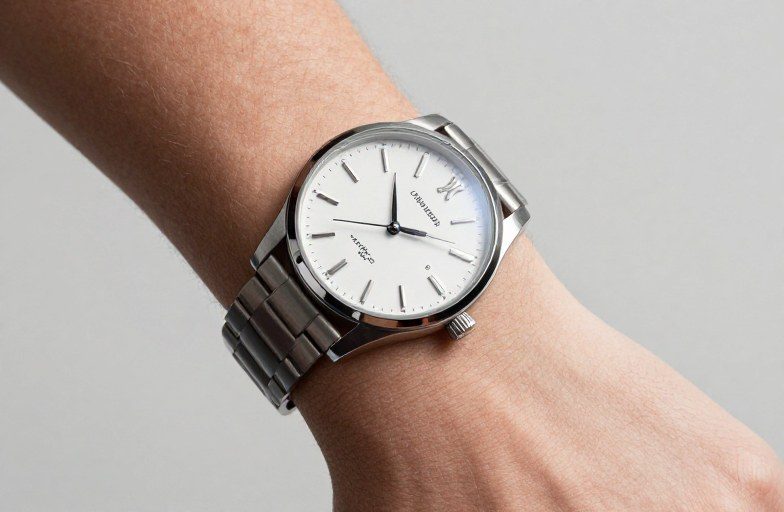
The wrist is the obvious and most literal choice, echoing where an actual timepiece sits. The inner wrist offers a more private viewing angle, while the outer wrist reads like you’re checking the time. Forearm placements, especially the outer forearm, give the artist more room for mechanical detail and let the watch face sit at a natural scale. The upper arm and shoulder work well for larger, more ornate pocket-watch variations with chains and filigree.
Size and Detail Considerations
Small watch faces, under two inches, lose legibility fast. Roman numerals blur, hands become sticks, and the mechanical illusion collapses. For a clean, readable piece, aim for at least three inches in diameter if you want numerals, or simplify to hash marks and minimal hands. Line-only designs age better at small sizes than heavy black-fill pieces, which can “blow out” and muddy the fine gears and springs.
Skin Movement and Aging
- Inner wrist skin moves constantly with hand rotation, accelerating blur on fine lines
- Outer wrist sees more sun exposure, fading color faster than black ink
- Forearm skin is more stable, preserving detail longer
- Areas near palm creases distort the circular watch face over time
History & Cultural Roots
Timepiece tattoos descend from two visual traditions: the memento mori art of medieval Europe, where skulls and hourglasses reminded viewers of death’s inevitability, and the Victorian era’s sentimental jewelry, lockets, hair-work brooches, and pocket watches engraved with dates of loss. The pocket watch specifically is often linked to 19th-century mourning culture, where a deceased loved one’s watch might be carried as a tangible keepsake.
From Pocket to Wrist
The wristwatch itself became common during World War I, when soldiers needed hands-free timekeeping. Tattoo adaptations followed this shift, with wrist-mounted designs replacing the dangling pocket watch on chains. Some trace the chained pocket watch tattoo to sailor and working-class traditions, where it signaled a man who valued punctuality and reliability, traits tied to employability and trust.
Prison and Street Associations
In some prison systems, a watch without hands or a broken face indicated a long sentence, time that felt meaningless or endless. A watch with specific hands could mark time served. These associations have largely faded in mainstream tattooing, but the image still carries residual weight in certain communities. Context matters: a ornate, realistic piece reads differently than a crude, single-needle version.
Symbolism & Core Meaning
The stopped watch is the most emotionally loaded variant. The frozen hands point to a birth time, a death time, a moment of survival or transformation. It’s specificity that makes it powerful, 3:17 isn’t decorative, it’s anchored to real events. The wearer knows; others sense the weight without knowing the details.
Running vs. Stopped
A watch with hands in motion suggests ongoing life, urgency, or the feeling that time is slipping away. A stopped watch is elegiac, it’s already happened, the moment is past, only the record remains. Some choose a watch with no hands at all, abstracting time into pure concept rather than event. This reads as more philosophical, less personal.
Common Companion Elements
- Roses or wilting flowers: beauty’s decay, love tied to a specific period
- Maps or coordinates: where the moment occurred
- Names and dates: literal documentation, sometimes considered visually heavy
- Smoke, melting, or fragmentation: time’s unreliability, memory’s distortion
- Chains: connection to someone lost, or the burden of time itself
Color vs Black and Grey
Black and grey dominates watch tattoos for good reason. The metallic surfaces, steel, brass, gold, are easier to suggest through greywash gradients than through flat color. A skilled artist can make skin read as polished chrome or aged bronze using only black ink diluted to different values. Color, when used, tends to appear in small accents: a red rose, blue enamel on a dial, green oxidation on copper details.
Color Risks and Rewards
Bright yellows and oranges for “gold” often heal muddy, looking more like infection than precious metal. Actual metallic effects come from contrast and reflection patterns, not literal gold ink. If you want color, consider it in the surrounding elements, flowers, backgrounds, ribbons, rather than the watch itself. This preserves the mechanical realism while adding emotional temperature.
Style Variations
- Photorealism: maximum detail, highest fade risk, requires large scale
- Traditional/Americana: bold lines, limited shading, readable for decades
- Neo-traditional: expanded color palette, stylized proportions, decorative flair
- Blackwork/dotwork: texture over illusion, graphic and modern
- Trash polka: watch elements fragmented with abstract red/black splatter
Similar & Related Symbols
The hourglass predates the watch in tattoo vocabulary and carries similar meanings with more archaic weight. It emphasizes time’s flow rather than mechanical measurement, sand falls, you can’t stop it, you can’t reverse it. Clock faces without watch bodies feel more institutional, less personal. Grandfather clocks suggest generational time, family lineage, the weight of inheritance.
Modern Alternatives
Digital readouts, atomic symbols, and even smartphone screens have appeared as timekeeping tattoos, but they lack the visual density and symbolic accumulation of analog mechanisms. A digital clock reads as “90s nostalgia” or “cyberpunk aesthetic” rather than universal human experience. The analog watch persists because its gears and springs are metaphorically rich, we see the mechanism, we understand the labor of keeping time.
Overlapping Motifs
- Compass + watch: direction and duration, journey measured in time
- Skull + watch: classic memento mori, death and time intertwined
- Eye + watch: surveillance, judgment, “your time is watched”
- Anchor + watch: stability against time’s passage, often naval service
Who Chooses This Tattoo
There’s no single demographic. Parents stop watches at children’s birth times. Survivors of accidents or illnesses mark the moment everything changed. Widows and widowers carry death times. Others choose it preemptively, a reminder before loss occurs, a commitment to valuing present hours. Some simply love mechanical objects, the visible engineering of gears and escapements.
Gender and Style Patterns
Historically more common among men, particularly in traditional and neo-traditional styles, the watch has broadened significantly. Women often choose smaller scales, more integration with floral or script elements, and placement on ribs, thighs, or behind the ear rather than wrist. The core meaning remains identical; the visual language adapts to personal aesthetic rather than fixed gender rules.
When It’s the Wrong Choice
A watch tattoo tied to a current romantic relationship carries obvious risk. The stopped-time motif becomes awkward if the relationship ends. Similarly, marking a trauma anniversary can feel re-traumatizing rather than healing for some. The permanence that makes tattoos meaningful can also make them oppressive. Consider whether you want to carry this specific timestamp for decades, or whether a more abstract time symbol would serve the same purpose with more flexibility.
Final Thoughts
The wrist watch tattoo endures because it does specific emotional work. It documents, it warns, it memorializes. The mechanical details aren’t mere decoration, they’re the metaphor made visible, time as something constructed, maintained, and ultimately stopped. Choose your hands carefully, scale it for the long term, and trust the image to carry what words can’t.
Frequently Asked Questions
What time should I set the hands to on a watch tattoo?
Set them to a meaningful moment, birth, death, survival, or transformation. Avoid random times; the specificity is what gives the tattoo weight. Some artists recommend avoiding 12:00 since it reads as a default rather than a choice.
Do watch tattoos age badly compared to other designs?
Fine mechanical details blur faster than bold traditional work, especially on wrist placement. Simplify gears to suggestion rather than engineering accuracy, and prioritize strong contrast over delicate linework for longevity.
Is a pocket watch different from a wrist watch in meaning?
Pocket watches carry more historical and mourning associations, often linked to Victorian keepsake culture. Wrist watches feel more modern and personal. The chain on a pocket watch adds narrative possibility, connection, binding, or inheritance.
Can I add color to a realistic watch tattoo without it looking fake?
Keep color in surrounding elements rather than the watch itself. Real metallic surfaces are achieved through greywash contrast, not gold or silver ink. Small accents, enamel dials, rose petals, add warmth without breaking the mechanical illusion.