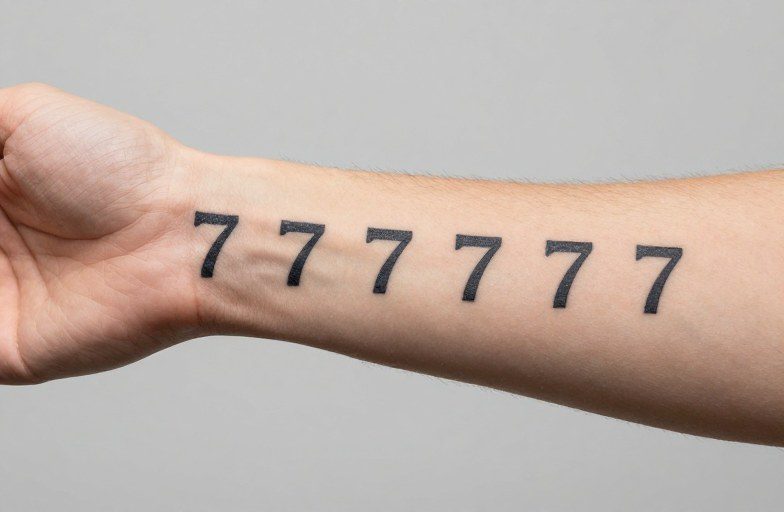
The 7 2 tattoo in military circles refers to an operational reality: the roughly 72-hour window after which survival odds for an isolated or captured service member drop sharply. On the wrist, these two digits become a private countdown, visible to the wearer with every glance at a watch or signature. It is not a mainstream design. It moves through word-of-mouth among veterans, special operations personnel, and the families who have waited through that window.
What the Numbers Mean
Unlike unit insignia or MOS codes, 7 2 carries no official documentation. Its power lies in what it omits. The wearer knows. Fellow veterans recognize it. Civilians pass by unaware.
The 72-Hour Window
Combat search and rescue doctrine treats the first 72 hours as critical for recovering isolated personnel. Weather, enemy movement, and physiological limits compress into this span. The tattoo compresses that operational reality into two digits. Some wear it to mark their own survival of an event; others to honor someone who did not make it back within that window. The meaning is not fixed. It is anchored to a specific understanding of time as a threat.
Why the Wrist
The wrist puts the number in the wearer’s sightline during daily tasks: checking a watch, signing a form, reaching for a door. That repetition matters. It is not a back piece seen only in mirrors; it is a constant, low-grade reminder. For those who have been isolated or waited on isolation, the wrist becomes the right place for a number that measures waiting.
- Visible to the wearer first, others second
- Heals relatively quickly compared to hands or fingers
- Easy to cover with a watch or sleeve for professional settings
- Small enough that two digits do not require scaling down to illegibility
History and Context
No ancient tradition directly attaches to 7 2 as a military symbol. The number seven carries weight across many cultures, completeness, cycles, luck, but the pairing with two is modern and utilitarian. The 72-hour rule is often linked to Cold War-era survival training, though documentation remains sparse. The tattoo itself probably emerged from special operations communities in recent decades, where informal marking traditions run strong. I would not claim a definitive origin date; the design’s value lies in its unofficial status.
Numbers as Military Shorthand
Soldiers have long used numbers as shorthand. Coordinates. Days in-country. The 7 2 fits this pattern but inverts it: it marks time not served, but potentially lost. In that sense, it shares DNA with POW/MIA imagery, though without the public recognition. The anonymity is part of the design.
Related Symbols and What to Avoid
Understanding what the 7 2 is not helps clarify what it is. It is not a unit tattoo. It is not a rank or qualification badge. It sits in a category of unofficial military ink that carries meaning within a small community.
Complementary Designs
Some pair the 7 2 with elements that reinforce context without explaining it. A broken chain link. A specific compass rose orientation. A single star or empty space where a name could go. These additions keep the code intact while personalizing it. The wrist’s limited real estate usually keeps the design minimal; adding too much risks turning a quiet signal into a cluttered explanation.
- Coordinates of a specific location, rendered small beneath the numbers
- A thin line above or below, suggesting a timeline or horizon
- Roman numerals instead of Arabic, harder to read at a glance, more private
- Negative space: the numbers cut out of a small black rectangle
Designs That Undermine the Code
American flag backgrounds, eagle motifs, or overt patriotic imagery tend to overwhelm the 7 2’s specificity. The number works because it is understated. Layering traditional military tattoo tropes on top turns a coded reference into generic veteran ink. Clock faces or hourglass imagery make the meaning too explicit, explaining what does not need explanation.
Technical Considerations
The wrist demands precision. Two digits, even simple ones, require clean line work to age well. Fuzzy edges or blowout from an inexperienced artist turn 7 2 into an unreadable blur within a few years.
Line Weight and Font
Thin lines look crisp initially but blur faster on the wrist, where skin flexes and sees sun. A moderate line weight holds definition without looking heavy. Sans-serif fonts or custom block lettering work better than ornate scripts. The goal is instant legibility at three feet for those who know, and plausible ambiguity for those who do not.
Color Decisions
Black ink ages most predictably. Red numbers fade to pink or orange depending on skin tone and sun exposure. White ink over black is technically possible but heals inconsistently on the wrist and often requires touch-ups. If color is non-negotiable, dark blue holds better than red or green.
Right vs. Left Wrist
The choice matters more than most assume. The right wrist, for right-handed wearers, sees more abrasion from writing, tools, and daily contact. The left wrist, typically watch-bearing, offers more protection but also more frequent sun exposure when the watch comes off. Consider which hand you use, whether you wear a watch, and which side you want in your peripheral vision. I have seen veterans choose the non-dominant wrist specifically to reduce wear, and others choose the dominant side to keep the number in their direct sightline.
How It Ages
Wrist tattoos age faster than most placements. The skin is thin, constantly moving, and rarely covered. The 7 2’s advantage is its simplicity: two characters, minimal detail to lose.
Long-Term Expectations
After five years, expect slight spreading of lines. After ten, the numbers may soften at edges but remain readable if the original work was solid. The wrist’s inner side, the palm-side or volar surface, fades faster and hurts more during application. The outer wrist, over the radius, holds ink better and heals with less irritation from daily contact.
- Moisturize regularly; dry skin accelerates fading
- SPF on the wrist is rarely applied but makes a visible difference over years
- Touch-ups are common at 7-10 years for wrist numerals
- During healing, avoid submerging in pools or hot tubs for two weeks
- Wear gloves for dishes and cleaning to protect fresh ink from chemicals and friction
Who Chooses This Design
The 7 2 does not appeal to the casually patriotic. It attracts those with direct connection to isolation, rescue, or the waiting that surrounds both. Combat search and rescue personnel. Pilots who know ejection and evasion timelines. Families who have lived through the notification and the window. Some get it after leaving service, when official channels no longer define their identity but the experiences remain.
Active Duty and Veteran Wearers
Active duty personnel sometimes hesitate due to visible tattoo regulations, though wrist placement is usually permissible under current U.S. military guidelines. Veterans face no such restriction and often choose the wrist precisely because they no longer wear a uniform that broadcasts their history. The tattoo becomes the uniform.
Before You Decide
Research the artist’s line work specifically. Ask to see healed wrist tattoos from their portfolio, not fresh photos. Fresh ink always looks sharper. Healed work reveals whether they understand how ink settles in that high-movement zone.
Consider whether you want the 7 2 to be recognizable to others who know the code, or entirely private. Font choice, placement, and whether you add contextual elements all shift this balance. The tattoo works best when it means something specific to you, not when it is chosen for aesthetic trend or vague military affiliation.
Be aware of how 72 reads outside military contexts. Tarot enthusiasts may think of the 72 spirits of the Goetia. Marathoners might confuse it with race distances. The misreading is not a problem, exactly, but it is part of the social reality you are accepting.
Finally, the wrist is a commitment to visibility. Even covered by a watch, the tattoo exists in your peripheral vision during most waking hours. Make sure the number you are carrying is one you want to live with that intimately.
Frequently Asked Questions
Does the 7 2 tattoo have an official military meaning?
No. It is not recognized by any branch or documented in regulations. It travels through informal veteran networks and carries weight only within communities familiar with the 72-hour recovery window.
Will a wrist tattoo affect my military career?
Current U.S. military tattoo policies generally allow wrist tattoos, but regulations vary by branch and change over time. Check your specific service’s latest directive before getting inked.
How painful is the wrist compared to other placements?
The wrist ranks moderate to high on pain scales due to thin skin and proximity to bone. The outer wrist over the radius tends to hurt less than the inner wrist near the palm.
Can I add color to a 7 2 military wrist tattoo?
Black ink ages most reliably on the wrist. Color fades faster in this high-sun, high-movement area. Dark blue is the most durable alternative if you want variation.