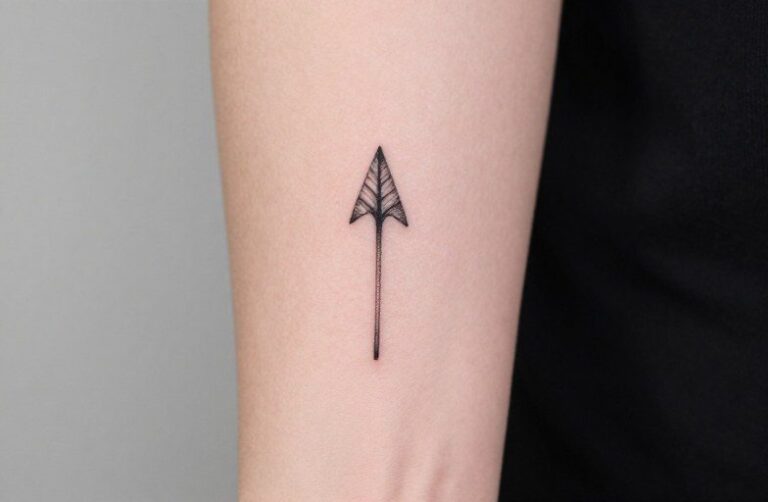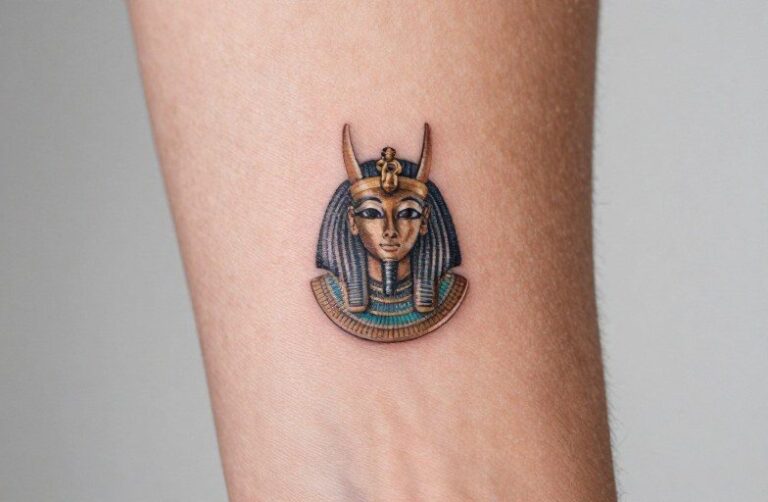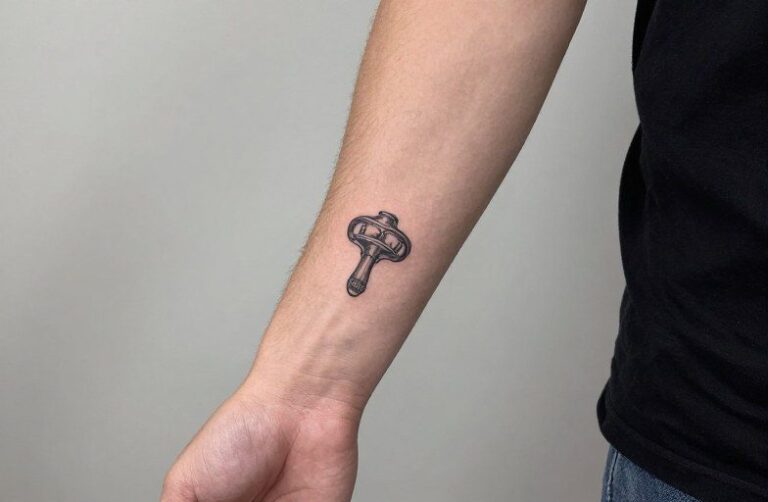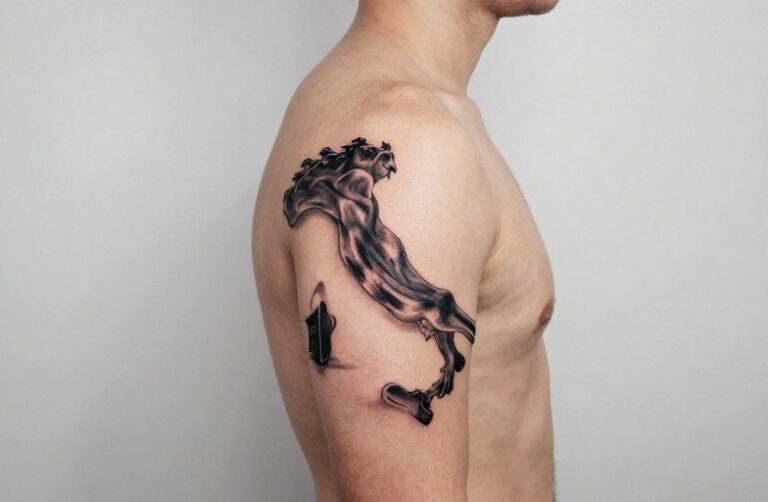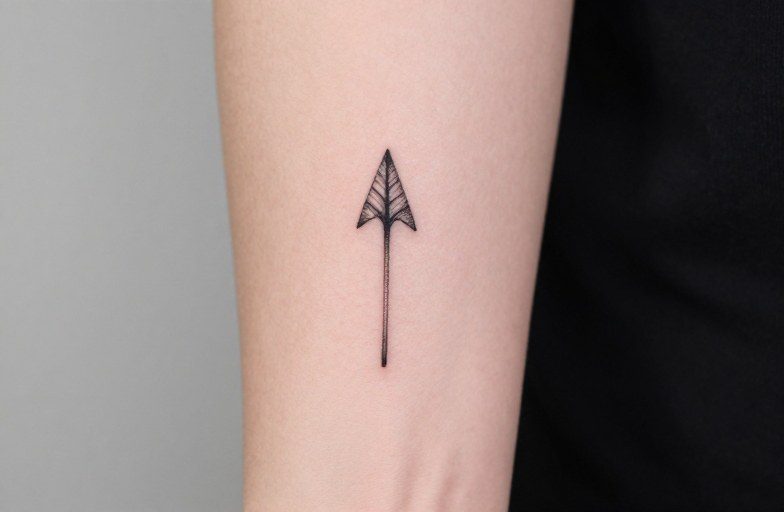
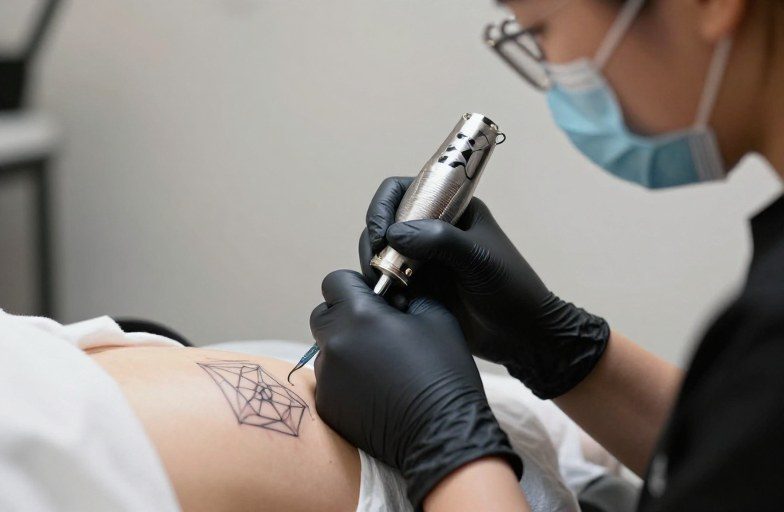
A geometric tattoo artist builds designs from mathematically precise shapes: circles, triangles, polygons, straight lines arranged into symmetrical patterns, mandalas, or abstract compositions. Unlike illustrators who draw freehand organic forms, these artists work with rulers, compasses, and stencils to ensure every angle measures true. The style demands steady hands, obsessive attention to proportion, and an understanding of how straight lines and perfect curves behave on the curved, moving surface of human skin.
Where the Style Comes From
Geometric patterning in skin art predates modern tattooing by millennia. Otzi the Iceman, the 5,300-year-old mummified body found in the Alps, carried parallel lines and simple cross patterns often linked to early therapeutic or ritual practices. Polynesian tapu and Maori ta moko developed intricate geometric language systems where specific angles and placements communicated genealogy and rank.
From Tribal to Contemporary Precision
Western tattooing absorbed bold black tribal geometry through the 1980s and 1990s, but the contemporary geometric style diverged sharply around the early 2000s. Artists began incorporating drafting tools, digital design programs, and mathematical concepts like the golden ratio and Fibonacci sequences. This precision-focused approach is often linked to sacred geometry traditions, Islamic girih tiles, Buddhist mandala construction, and Platonic solids, filtered through a modern minimalist aesthetic.
The Sacred Geometry Connection
Many geometric tattoo artists draw explicitly from sacred geometry, the study of proportional patterns found throughout nature and architecture. The Flower of Life, Metatron’s Cube, and Sri Yantra appear frequently. Clients arrive with varied intentions, some seeking personal symbolism, others drawn purely to the visual order. The artist’s task is consistent: execute these complex interlocking forms with accuracy that will read clearly years later.
Recognizing the Substyles
Geometric tattooing has splintered into several recognizable approaches, each with distinct technical requirements.
- Dotwork/Pointillism Geometry: Shading and form built entirely from stippled dots rather than solid black fill or smooth gradients. This creates soft tonal transitions impossible with line alone, but requires immense patience and dense, uniform dot packing.
- Blackout Geometry: Large fields of solid black ink with negative-space geometric shapes carved out. Demands confident, consistent saturation; patchy black reads as unfinished immediately.
- Geometric Realism: Animal or human portraits deconstructed into polygonal facets, associated with the low-poly digital art movement. This blurs the line between geometric and illustrative styles and requires mastery of both.
- Ornamental/Decorative: Lace-like patterns, mehndi-inspired frameworks, and jewelry-adjacent designs wrapping limbs or framing other tattoos. Prioritizes flow with body contours over standalone symbolism.
Some artists hybridize freely, combining dotwork mandalas with realistic single-eye centers, or layering fine-line geometric sleeves over blackout foundations. Others commit to a single approach and build their reputation there.
How to Read the Technical Work
Identifying genuine geometric tattoo skill requires knowing what technical excellence looks like.
- Line weight consistency: A single straight line should maintain identical thickness throughout. Tapering where unintended, wobbling, or blobbing at ends indicates shaky hands or poor machine control.
- Circle perfection: True circles, not ovals, on flat skin. Ellipses are acceptable only when intentionally compensating for curved body planes.
- Clean intersections: Where lines cross, ink should not pool or blur. Sharp, distinct crossings demonstrate proper needle depth and angle.
- Dotwork uniformity: In stippled shading, dots should distribute evenly with consistent size and spacing. Clustering, drifting patterns, or varying dot density reveal rushed or unpracticed technique.
Recurring Motifs
Platonic solids (tetrahedron, cube, octahedron, dodecahedron, icosahedron) appear constantly, often nested or intersecting. Mandalas radiate from central points with repeating symmetrical units. Metatron’s Cube and Flower of Life patterns overlay multiple circles at specific intersecting angles. Animal forms, wolves, bears, owls, deconstruct into triangular facets in geometric realism substyles. Dotwork artists frequently render sacred geometry with stippled gradients that soften the otherwise hard edges of pure linework.
Placement and What Skin Does to Geometry
Geometric designs succeed or fail dramatically based on placement choice. The style’s reliance on straight lines and perfect circles makes certain body areas genuinely difficult.
Flat, Stable Surfaces
The outer forearm, outer calf, and upper back between shoulder blades offer relatively stable skin with minimal distortion during movement. These areas accommodate large symmetrical pieces, full mandalas, sleeve-spanning patterns, or back pieces with central focal points. The forearm’s visibility also suits smaller, detail-dense compositions: single Platonic solids, minimal line clusters, or small dotwork pieces.
Challenging Curves
Ribs, elbows, knees, and inner biceps present problems. Skin stretches and compresses unpredictably; a perfect circle drawn relaxed becomes an oval when flexed. Experienced geometric artists account for this in the design phase, sometimes tattooing with the limb positioned mid-movement. Armpits and sternum skin shift so dramatically that complex geometry here rarely ages cleanly. Simple, bold patterns outperform intricate detail in these locations.
Hands and feet remain problematic for longevity regardless of style, but geometric work suffers especially. Fine lines blur fastest here; solid black geometric shapes tend to hold better than hair-thin constructions.
Color, Black, and Longevity
Traditional geometric tattooing remains predominantly black ink, but color integration has grown significantly.
Black and Grey Dominance
Black linework offers maximum longevity and contrast. On light to medium skin tones, crisp black geometry maintains definition for decades with minimal fading to muddy grey. Dotwork shading in black creates subtle grey tones without introducing color instability. The stark graphic quality suits the style’s mathematical, almost architectural character.
Color Applications
Contemporary artists increasingly incorporate limited color palettes, single accent hues, watercolor washes bleeding outside geometric boundaries, or gradient fills within polygonal cells. These require different technical approaches: color packing versus line work, understanding how pigments fade differentially (reds and yellows faster than blues and blacks), and planning for the muting that occurs as tattoos age. Color geometric pieces often need earlier touch-ups to maintain intended effect.
White ink highlights on black geometric backgrounds create striking immediate results but typically yellow or disappear entirely within a few years. Artists committed to longevity use white sparingly, if at all.
Common Mistakes
Both clients and artists stumble repeatedly in this style. Recognition prevents costly, permanent errors.
- Overly complex scaling: Designs packed with dozens of interlocking shapes at small sizes blur together within years. Lines merge; dots become indistinct smudges. Bold simplicity at smaller scales, complexity reserved for larger pieces.
- Ignoring skin undertone: Heavy black geometric work on very dark skin requires adjusted contrast strategies, thicker lines, more negative space, less reliance on fine dotwork that may not read clearly.
- Symmetry shortcuts: Freehanding what should be mirrored produces subtle asymmetries that read as amateur once noticed. Proper geometric artists measure, stencil, and sometimes work with both hands to maintain balance.
- Designs that ignore anatomy: A rigid geometric band wrapping a forearm without accounting for the radius and ulna rotation will distort noticeably when the wrist turns. Good artists flow geometry with muscle direction, not against it.
The Copycat Problem
Pinterest and Instagram circulate identical geometric designs endlessly. Reputable artists refuse to replicate another’s custom work. Clients requesting an exact mandala from a photograph should expect adaptation or refusal. The style’s mathematical foundation makes independent creation possible; artists generating original patterns from geometric principles produce work that actually fits the body and holds personal meaning.
What to Remember
Geometric tattooing rewards patience on both sides of the needle. For clients, this means researching artists thoroughly, prioritizing technical precision over trendiness, and accepting that the best practitioners often book months ahead. For artists, the style demands continuous refinement of basic skills, line, circle, intersection, that never become automatic because skin is always variable.
The best geometric work does not announce itself loudly. It sits quietly on the body, lines still true after years of sun and movement, patterns that draw the eye without shouting. That restraint is the point. Mathematics offers its own authority; the artist’s job is to translate it faithfully onto living, changing skin.
Frequently Asked Questions
How do I find a skilled geometric tattoo artist?
Look for portfolios showing consistent line weight, perfect circles on flat skin, and clean intersections. Ask specifically about their stencil process and whether they use drafting tools. Avoid artists whose geometric work shows wobbling, asymmetry, or blown-out lines.
Does geometric tattooing hurt more than other styles?
Not necessarily more, but differently. Long straight lines and dense black fill require the artist to work methodically, sometimes over the same area repeatedly. Dotwork can feel like prolonged irritation rather than sharp individual pricks. The sensation depends heavily on placement.
How much should I expect to pay?
Geometric specialists typically charge premium rates due to the technical precision required. Complex mandalas or full sleeves from established artists can run into thousands. Small, simple pieces may start at a few hundred. The investment reflects time, not just materials.
How do geometric tattoos age?
Bold black linework ages best. Fine lines and dense small-scale detail tend to blur and merge over 10-15 years. Dotwork softens but often remains readable longer than equivalent fine lines. Color accents fade faster than black. Sun protection is essential for longevity.