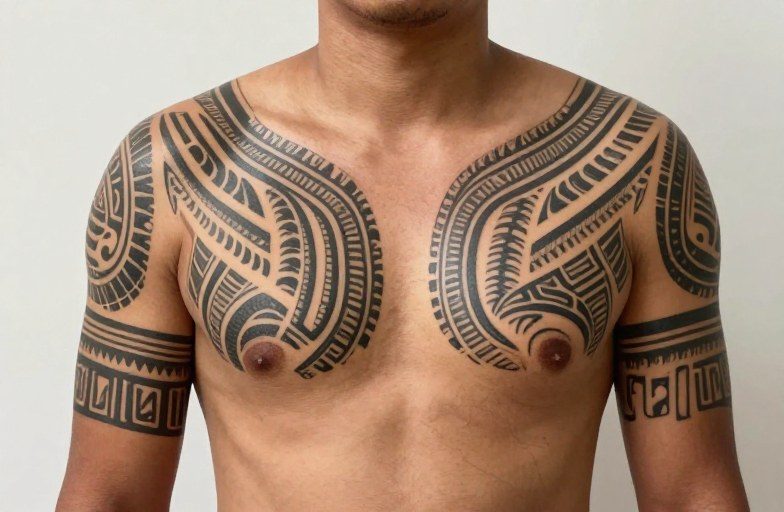
Filipino tribal tattooing stretches back centuries before Spanish contact, with regional styles so distinct that a practiced eye could once identify a wearer’s island and status. Batok, the hand-tapped method often linked to the Kalinga people of the northern Cordilleras, differs sharply from the curvilinear flow of Visayan pintados or the bold geometric blocks of Mindanao. Today, people seek these designs not for social rank but for reconnection: to heritage, to resilience, to a visual language that colonization suppressed but never fully erased. Understanding what the patterns actually signify helps you choose something that resonates beyond surface aesthetics.
Matching and Pairing Ideas
Filipino tribal patterns work best when paired with elements that ground them in personal meaning rather than generic exoticism. The traditional vocabulary offers specific tools for this.
Ancestral Combinations
A family name or birth year framed in a gabay pattern draws on the repeating triangular motifs that were often linked to protection during travel. The lingling-o shape, an ancient symbol found in pre-colonial goldwork with associations to fertility and prosperity, pairs naturally with a parent’s or grandparent’s signature. Its elongated oval with pointed ends translates cleanly into negative space, letting skin breathe through the design.
For siblings or couples, the binakol weave pattern, based on basketry designs, creates visual rhythm that can be split across two bodies and rejoined when standing together. Unlike Western tribal’s random blackwork, binakol follows strict mathematical repetition. Each segment must align precisely, so your artist needs experience with geometric construction.
Modern Hybrid Approaches
- Baybayin script (pre-colonial Philippine syllabary) integrated into negative space within larger tribal fields
- Philippine sun rays emerging from behind traditional shoulder armor patterns
- Specific flora, sampaguita, anahaw, or narra, rendered in the same angular language as the surrounding tribal work
Mixing regional styles requires care. Kalinga patterns from the Cordilleras and Maranao okir from Mindanao come from distinct cultural contexts. Combining them without understanding reads as pan-tribal flattening. Better to commit deeply to one tradition.
Best Placements
Traditional placement carried specific meaning. Pintados of the Visayas wore full chest and back pieces. Kalinga women received throat tattoos and hand tattoos as markers of status and accomplishment. You are not bound by these historical functions, but knowing them informs respectful choices.
Scale and Flow
Filipino tribal relies on continuous flow. The fatek (centipede) pattern, often linked to protection and warrior spirit, needs length to develop its rhythmic legs. Forearm, calf, or side torso work best. Chest panels require substantial commitment: sparse patterning looks like a sticker, while dense coverage demands multiple sessions and significant black saturation.
Hand and finger placements age poorly. The traditional hand tattoos of Kalinga women were maintained through constant re-tapping. Modern machine work on fingers typically needs touch-up within two years as the dense black diffuses through thin skin. If you want this placement, budget for maintenance.
Working with Body Geometry
Spine channels suit the straight-line sinag (sun ray) motifs. The shoulder cap traditionally displayed rank markers. Ribs and flanks accommodate the organic flow of okir vine patterns, which follow muscle movement rather than fight against it.
For First-Timers
Blackwork saturation hurts more than fine-line work, and Filipino tribal demands heavy black. The repeated tapping of hand-poked batok distributes trauma differently than machine work. Some find it more tolerable, others less. Machine execution of these patterns requires solid black fill; there is no shading shortcut.
What to Expect During Healing
Large black areas produce significant plasma weeping for the first 48 hours. Sleep on clean towels. The thick scab that forms over dense blackwork often cracks if the skin dries out. Unscented lotion applied thinly and frequently prevents this. Color loss in heavy black is usually uneven, patches where the scab pulled too early. Resist picking. Plan a touch-up at 6-8 weeks, especially for solid fill areas.
Research Before Committing
- Verify your artist has executed geometric tribal before. Ask to see healed photos, not just fresh work.
- Black ink in tribal work often contains carbon-heavy formulations. Note any allergies to specific brands.
- Budget 20-30% more time than comparable non-tribal pieces. The precision of line weight and negative space cannot be rushed.
Popular Styles
Three regional traditions dominate contemporary interpretation, each with distinct visual grammar.
Cordilleran Batok
Whang-Od Oggay’s fame has focused global attention on Kalinga patterns: the centipede, the rice bundles, the eagle. These are built from repeated geometric stamps, each tapped individually with thorn and pomelo bark hammer. Machine replication requires the artist to maintain the slight irregularity that gives hand-tapped work its living quality. Too perfect looks mechanical; too loose looks sloppy. The fang-od (rice mortars) pattern is often linked to agricultural abundance and community labor.
Visayan Pintados
Spanish chroniclers described full-body coverage resembling armor. Surviving visual references come from the Boxer Codex, a 16th-century manuscript. Pintado patterns flow in curvilinear waves across the torso, less rigid than Polynesian counterparts. The style suits larger pieces where the pattern can breathe and move. Contemporary artists often adapt the wave forms into sleeve work that wraps naturally around the arm’s cylinder.
Maranao Okir
From the southern Philippines, okir features the naga (serpent) and pako (fern) in continuous scrollwork. Traditionally carved in wood and applied to architecture and metalwork, its adaptation to skin requires simplification. The finest woodcut details blur at tattoo scale. Okir works exceptionally well as framing elements, bordering larger compositions with rhythmic plant-derived geometry.
How to Personalize It
Generic tribal sleeves read as cultural tourism. Personalization requires engaging with specific meaning, not just aesthetic preference.
Family and Regional Specificity
If your family traces to a specific region, research that area’s patterns specifically. Ilocano tattooing differed from Pangasinan; both differed from Kalinga. The burik (dots) pattern of the Bontoc is often linked to headhunting and status, but appropriating it without that lineage distorts its function. Better to adapt the kinabu (life) pattern, a general protective motif, or commission a contemporary artist from that tradition to design something that honors without falsely claiming status.
Integrating Personal Symbols
Baybayin offers direct textual integration. The script’s flowing curves contrast with tribal angularity. Skilled artists weave syllables into pattern breaks so they read as design elements first, text second. Your name, a parent’s name, or a concept like lakas (strength) or loob (inner will) becomes structural rather than decorative.
Some choose to map ancestral migration: a Cordilleran pattern transitioning to Visayan waves, perhaps with a specific island’s coordinates in negative space. This requires an artist comfortable with both traditions and willing to research rather than improvise.
Contemporary Directions
Filipino tattoo artists in the Philippines and the diaspora are pushing beyond faithful reproduction into deliberate evolution. This creates both opportunity and tension.
Deconstructed Blackwork
Artists like Elle Mana-Festin and others in the diaspora community fragment traditional patterns into scattered elements across the body: single centipede legs, isolated rice bundles, partial sun rays. The negative space dominates; the tribal becomes suggestion rather than statement. This suits those who want reference without full commitment to historical coverage. The risk is real: without enough context, the fragments read as abstract blackwork, losing the cultural connection entirely. The viewer sees a shape, not a story.
Color Integration
Traditional batok was black only. Soot and thorn produced no color range. Contemporary artists occasionally introduce limited earth tones, ochre or deep indigo, drawn from Philippine textile traditions like the T’boli t’nalak. This is not historical reconstruction but deliberate extension. The question for you is whether you want the aesthetic of tradition or its actual constraints. Color shifts the register from ancestor reference to contemporary art statement. Neither is wrong, but the distinction matters.
The Appropriation Problem
The 2010s saw a boom in Filipino Americans seeking tribal tattoos as heritage reclamation. The intention was genuine; the execution often was not. Artists with no connection to specific communities reproduced Kalinga patterns for clients with no Kalinga ancestry. Whang-Od’s village of Buscalan became a tourist destination, with visitors seeking “authentic” batok as cultural consumption. If you are not Kalinga, receiving hand-tapped batok from Whang-Od or her apprentices raises real questions about whose tradition you are wearing and under what terms. Some diaspora artists now refuse certain patterns entirely, directing clients to motifs with broader regional use or to purely contemporary designs that reference without claiming.
Before You Decide
Filipino tribal tattooing carries weight that Polynesian or Maori work has long been recognized for, but with less mainstream visibility. This means less guidance and more room for misstep. The patterns are not a style to collect. They are a language that was nearly silenced, now spoken again in changed conditions.
Your first step is not choosing a design but identifying your actual connection. Genetic testing showing 23% Filipino ancestry does not automatically translate to a Kalinga centipede on your forearm. Neither does general pride in Filipino identity. The most respectful pieces come from specific research: a region, a family story, a documented pattern whose meaning you can explain without notes. If that specificity is not available to you, contemporary artists working in a Filipino visual vocabulary can create something that references the tradition without occupying it.
Talk to multiple artists. Ask how they learned their patterns, who their teachers were, whether they have worked with the communities whose designs they use. Ask to see healed work from two years prior, not just fresh photos. Ask what they will not tattoo and why. An artist with no boundaries has no depth.
The pain is significant, the healing is demanding, and the commitment is permanent. But the result, done well, is not decoration. It is a visible answer to a question about where you come from and what you choose to carry forward.
Frequently Asked Questions
Do I need Filipino ancestry to get a Filipino tribal tattoo?
No legal or universal rule exists, but the ethics depend on your connection and the specific pattern. General Filipino identity or distant ancestry does not automatically justify wearing patterns from specific Indigenous communities like the Kalinga. Some diaspora artists will guide you toward motifs with broader regional use or create contemporary designs that reference without claiming. The key is honest conversation with your artist about what you actually have permission to wear, not just what you have desire for.
How do I find an artist who actually knows Filipino tribal patterns?
Look for artists who can name their teachers and sources, who have worked in the Philippines or with diaspora communities, and who show healed geometric tribal work from years past. Ask specifically about their research process. Avoid artists who treat all tribal as interchangeable or who cannot explain the difference between Kalinga, Visayan, and Maranao visual grammar. Several respected practitioners are based in Manila, Baguio, and diaspora hubs like Los Angeles and the Bay Area.
Is hand-tapped batok better than machine work for Filipino tribal?
Hand-tapped batok by trained practitioners carries cultural specificity that machine work cannot replicate, but it is not automatically “better.” The Kalinga method uses thorn and pomelo bark hammer with specific ritual context. If you are not Kalinga and not receiving it in that context, machine work by an artist who understands the patterns may be more appropriate. The question is not technique but relationship: who is doing the work, why, and with what understanding of what it means.