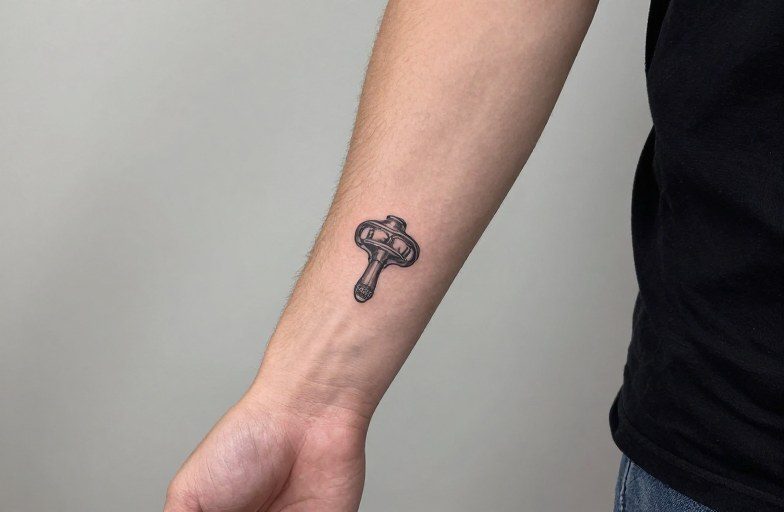
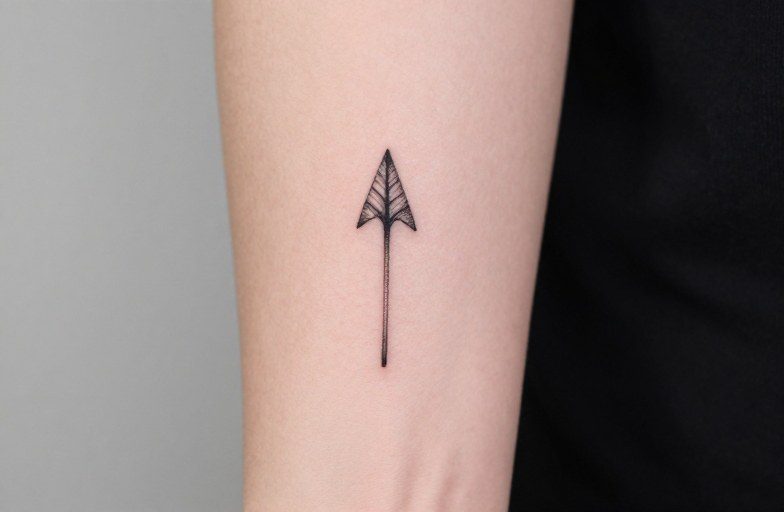
Arrows are among the oldest human symbols, and shrinking them down doesn’t dilute their weight. A small arrow tattoo compresses ideas of direction, protection, and forward movement into something that reads clearly even at a few centimeters long. The meaning shifts depending on how you orient it, what you pair it with, and where you place it on the body. This guide breaks down the practical decisions that turn a simple arrow into something that actually works for you.
Matching & Pairing Ideas
Companions That Add Context
Arrows play well with other small imagery because the form is so legible. A bow, drawn or at rest, changes the reading from “moving forward” to “potential energy” or “readiness.” Feathers attached to the shaft traditionally suggest travel, lightness, or a specific connection, many people choose a feather from a particular bird for personal reasons. Roman numerals running along the shaft can mark a date without requiring a separate element. Words, when lettered small enough to fit, work best in a clean sans-serif or typewriter face; script at this scale blurs faster than you’d expect.
Geometric additions, circles, triangles, broken lines, push the symbol toward abstract territory. A triangle behind the arrow point reads as “direction with purpose.” A circle through the shaft suggests cycles, repetition, or a target. These pairings work because they don’t compete visually; the arrow remains the dominant form.
Multiple Arrows
Two arrows crossed form an X, a common friendship or relationship marker. Parallel arrows, same direction, suggest solidarity or shared path. Parallel arrows, opposite directions, create tension, some people want that push-pull, others find it reads as confusion. Three arrows in a bundle, a design often linked to Native American symbolism, traditionally represents strength in community. If you’re drawn to that specific configuration, research its origins rather than treating it as generic “tribal” decoration.
Size & Scale
Small arrow tattoos typically run between one and three inches. At the smaller end, you’re looking at a single needle or very tight three-round liner work. The fletching (feathering) at the back and the arrowhead at the front need distinct geometry to read as an arrow rather than a random line. Below an inch, those details start to collapse into each other after a few years of aging and sun exposure.
At two to three inches, you gain room for subtle tapering in the shaft, a clean barb on the head, and maybe a single accent like a small gemstone or geometric break. This is the sweet spot for most first small tattoos, big enough to hold detail, small enough to hide or reveal at will. Shading in a small arrow should be minimal; soft greywash can suggest dimension, but heavy black fill at this scale often heals patchy and ages into a blob.
Popular Styles
Linework and Fine Line
The majority of small arrows are done in single-needle or three-liner black work. Fine line specialists can achieve hair-thin shafts that look almost drawn on, but this requires a steady hand and, more importantly, steady aftercare from you. Thin lines spread more readily than bold ones. A clean, consistent line weight throughout the shaft reads more timeless than the ultra-delicate approach that’s trending on social media right now.
Blackwork and Dotwork
Some arrows are built entirely from stippled gradients or solid black negative space. The arrow emerges from the skin rather than sitting on top of it. This style holds up better over decades but requires more skin real estate to work, usually two inches minimum to avoid the dot pattern looking like a smudge. Dotwork arrows pair naturally with mandala or sacred geometry contexts.
- Minimalist geometric: Perfectly straight digital-looking lines, often with mathematical precision. Works best on flat skin areas where the line won’t distort with movement.
- Hand-poked: Slightly irregular, organic line quality. Heals differently than machine work, often softer, sometimes lighter. The imperfection is the point.
- Traditional/Americana: Bold black outline, limited color, classic arrowhead shape. Even at small sizes, this style relies on strong contrast rather than detail.
For First-Timers
An arrow is a common first tattoo for good reason: the shape is universally understood, the session is short (usually under an hour), and the pain tends to be manageable on most placements. But the simplicity is also a trap. Because the design looks easy, people sometimes choose artists based on convenience rather than skill. A crooked arrow is a crooked arrow forever. The straightness of the shaft, the symmetry of the head, the balance of the fletching, these are technical elements that separate competent work from work you’ll notice every time you look down.
Ask to see healed photos, not just fresh ones. Redness and swelling hide imperfections. A healed arrow shows whether the line weight stayed consistent, whether the points stayed sharp, whether any blowout occurred along the edges. Most reputable artists have these in their portfolios or social media archives.
Tips for Choosing
Direction Matters
An arrow pointing up reads as aspiration, growth, aiming higher. Downward can suggest grounding, descent into the underworld, or simply following gravity’s pull. Forward (horizontally) is the most neutral, movement, progress, onward. Backward is rare and usually reads as regression unless paired with something that recontextualizes it. Consider not just what the arrow means in isolation, but how it will interact with your body in motion. An arrow following the line of your forearm moves with your gesture; one across your wrist stays static as you type or write.
Personal vs. Universal Symbolism
The bow-and-arrow hunting connection, the Cupid/love association, the Sagittarius zodiac link, the “arrow must be pulled back to shoot forward” metaphor, these are all available to you, but none are automatic. If symbolic weight matters to you, small tattoos for men with real meaning covers how intention shapes a design beyond the obvious choices. The meaning attaches through your intention and context, not through the image itself. If you’re getting matching arrows with someone, discuss orientation beforehand. Mirrored arrows can read as “facing each other” or “moving apart” depending on placement.
Best Placements
Arrows work almost anywhere because the form is so adaptable to body contours, but some placements solve specific problems.
- Along the forearm: Natural movement line, easy to show or cover with a sleeve. The shaft follows the ulna/radius direction. Flat surface means the line stays straight. See how this works in practice with small forearm tattoo ideas for men.
- Behind the ear: Hidden, intimate. The curve of the skull means the arrow will arc slightly unless placed carefully. Small scale, usually one inch or less.
- Along the collarbone: Horizontal orientation reads well here. The bone provides a visual anchor. Pain is sharper due to proximity to bone.
- Inner bicep: Soft skin, moderate pain, easy to conceal. The cylinder shape means the arrow wraps slightly, which can be used intentionally or avoided with a shorter design.
- Ankle/achilles: Vertical placement follows the tendon line. High movement area means slightly faster fading. Popular for “forward motion” symbolism because of the walking/running association.
- Finger: High visibility, high regret potential. Finger skin sheds and regenerates faster; arrows here often need touchups within a few years. The side of the finger holds better than the top pad.
Ribcage and sternum placements work for larger arrow designs but rarely for small ones, the curvature distorts the straight line too much unless the arrow is oriented to follow a specific rib or the sternum’s center line.
Final Word
A small arrow tattoo succeeds or fails on precision. The concept is simple enough that there’s nowhere for technical flaws to hide. Spend your research time on the artist’s straight lines and healed results, not just on Pinterest boards of what looks cool fresh. The meaning you bring matters, but it lives in the execution too, in the confidence of the line, the intention of the placement, the care of the healing. Get the technical side right, and the symbolism takes care of itself.
Frequently Asked Questions
Do small arrow tattoos fade faster than larger ones?
All tattoos fade, but very fine lines in small arrows can blur or spread more noticeably because there’s less ink deposit to begin with. Bold, clean lines at a readable minimum size tend to age better than hair-thin details.
How much does a small arrow tattoo typically cost?
Most shops have a minimum charge that covers small simple work, usually reflecting the setup time and supplies regardless of design size. Expect to pay that minimum for a single small arrow, with costs rising if you add complex pairing elements or color.
Can an arrow tattoo cover an existing tattoo or scar?
Arrows can work over light scars if the scar tissue is fully healed and flat, but the line may sit differently on scarred skin. Covering existing dark tattoos with a small arrow rarely works because the new ink needs negative space to read clearly.
What’s the most common mistake people make with arrow tattoo placement?
Choosing a spot for visibility without considering how the arrow interacts with body movement and natural lines. An arrow that looks straight when you’re standing still may twist or compress when you bend the joint it’s near.