
Delicate ear tattoo ideas can stay crisp for years when you choose a readable silhouette, leave breathing room, and respect how thin lines age. I learned that after a tiny crescent blurred where hair and sun kept rubbing it. This guide covers placement, scale, artist choice, healing, cost, and aftercare. Small decisions matter!
Before you book, compare delicate minimal tattoo designs with your saved references. The strongest ideas usually feel crisp, minimal, and personal at the same time.
- Start With A Tiny Crescent Behind The Ear
- How Should Fine Botanical Sprigs Follow The Helix?
- The Single Star Beneath The Lobe
- Trace A Delicate Wave Around The Ear
- Which Initials Belong Behind The Earlobe?
- Moon Phases Along The Rim
- Match Tiny Twin Symbols Behind Both Ears
- What Makes An Intricate Celestial Constellation Work?
- A Dainty Birth Flower On The Helix
- Plan A Sleek Heart At The Ear’s Edge
- Embrace A Unique Whispered Word Behind The Ear
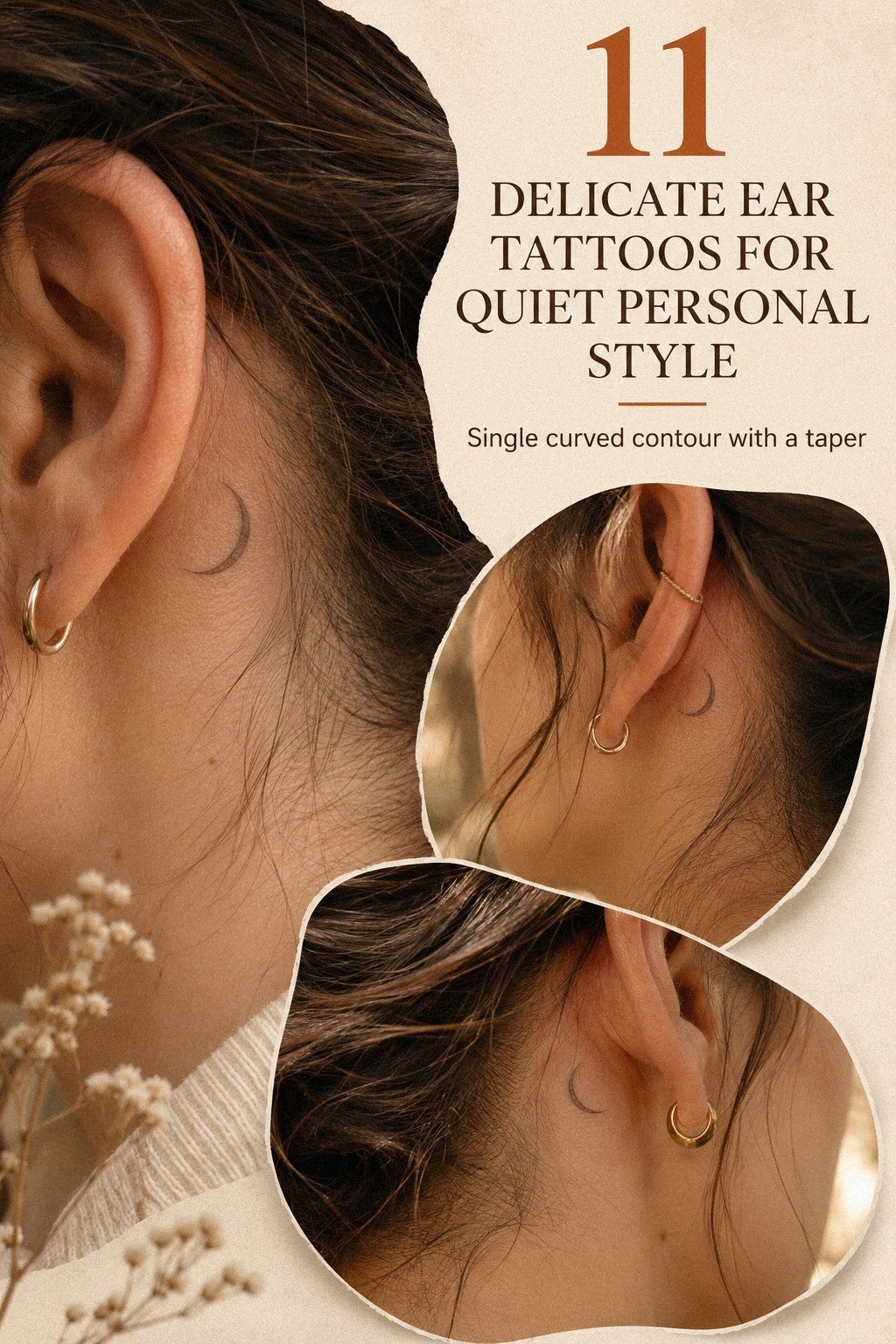
1Start With A Tiny Crescent Behind The Ear

Begin with the smallest shape that still reads from a short distance. A crescent behind the ear can feel minimal, symbolic, and personal when its curve has enough open skin around it. Start small!
Before you approve the stencil, tilt your head forward and turn your neck. You’ll see how the ear fold changes when you move. I’d place the crescent near the center and add only one or two supporting stars instead of stacking every mark at the same height.
Discuss the final size in inches or centimeters, not from a saved design. A dainty design can lose its edges when reduced too far. Show your artist the small ear tattoo ideas you’ve saved, then ask which details will survive healing.
Use a clean stencil and check it from the side, not only in the mirror. Transfer paper should follow the curve without wrinkling, and the lowest point shouldn’t touch the crease behind your lobe. I made that mistake once with a placement that looked centered until I moved my jaw.
This is what I call the Tiny Crescent Rule: one dominant shape, two supporting marks, and enough skin around them to keep the design sharp. If your reference looks busy at thumbnail size, simplify it before the needle starts. A sharp silhouette will usually outlast delicate decoration.
2How Should Fine Botanical Sprigs Follow The Helix?

For a botanical design, follow the outer helix with a narrow sprig that bends naturally around the ear. Keep the leaves crisp and the spacing open so the result stays graceful rather than crowded.
A restrained sprig can feel intricate, romantic, and timeless without needing a large tattoo. Ask your artist to simplify any tiny veins that may soften during healing.
3The Single Star Beneath The Lobe

A single star beneath the lobe works because it gives the eye one clear destination. The design can be dainty without becoming fragile, especially when the points remain open and distinct.
Ask your artist to test the star outline while your jaw moves. The lobe shifts when you speak, smile, or turn your head, so a shape that looks centered at rest may need a slight adjustment.
I’d choose a crisp five-point star, a sharp four-point sparkle, or a tiny symbolic mark rather than a cluster of competing shapes. A fierce little shape can still feel refined. That’s the point!
A small star can be a good budget choice because it needs less detail and may take less time. Still, a low price shouldn’t outweigh a healed portfolio or hygienic practice. Ask whether the studio minimum applies before you reserve the appointment.
4Trace A Delicate Wave Around The Ear

A wave behind the ear depends on movement more than size. Start with one sweeping line that follows the ear’s natural arc, then add only a few short breaks where the curve turns. The result can feel powerful without becoming loud.
Your artist can test the flow with a paper drawing before applying the stencil. Watch whether the crest points toward your face or away from it. I prefer the forward-facing crest because it feels powerful and personal, but your profile may suit the opposite direction.
Those breaks should be spaced farther apart than you think. Stencil gel can help the transfer stay clear, though the main issue is design discipline. Too many marks turn the wave into visual noise after the skin settles.
The ear moves constantly when you speak, smile, or turn your head. Ask your artist to show the stencil while you rotate your neck, then choose the angle that keeps the curve graceful.
I’d avoid adding a quote, shell, moon, and star to this idea. The single wave is already striking, raw, and quietly romantic. Compare it with delicate minimal tattoo designs and notice which examples still read clearly at a glance.
5Which Initials Belong Behind The Earlobe?

The best initials are meaningful, legible, and comfortable to keep private. Test whether each letter remains clear when reduced to the intended size before you commit to the letter scale.
Ask for several versions in different type styles. A sharp serif can feel classic and polished, while a loose handwritten form may feel more intimate. I’d avoid ultra-thin connecting strokes because they’re often the first details to soften.
Your artist should draw the letters with the ear’s movement in mind. Stencil paper gives you a preview, but you’ll also want to see the design on your actual skin. Turn your head, tuck your hair behind your ear, and check whether the initials disappear into the fold.
A meaningful tattoo doesn’t need to explain itself to everyone. You’re choosing a private reference, not creating a sign for strangers to read. If the initials belong to someone else, make sure the form still feels personal to you.
I’d choose deep emerald for the smallest letter sections and leave tiny counters open where possible. This idea can look feminine, masculine, or entirely neutral depending on the lettering, so trust your own visual language. Browse unique delicate ear tattoo ideas before settling on a style.
6Moon Phases Along The Rim

Moon phases can look sacred and ethereal when each crescent has enough separation from the next. A short sequence along the rim creates a quiet rhythm without requiring a large tattoo.
Ask your artist to check the moon-phase spacing at several angles. The rim curves sharply, and equal gaps on a flat drawing may not look equal once the stencil follows your ear.
You can choose three phases for a minimal approach or five for a more complete progression. I’d avoid filling every crescent heavily if your priority is long-term clarity. Strong outlines and deliberate gaps usually offer better value than decorative micro-detail.
Dark skin, warm undertones, and fair skin can all support a bold celestial idea, but pigment choice and contrast should be discussed in person. Look for an artist who shows healed work across different skin tones. The minimalist ear tattoo ideas you save can help you compare spacing, not just symbolism.
7Match Tiny Twin Symbols Behind Both Ears

Twin symbols need balance without looking mechanically copied. Your ears aren’t identical, so the artist may mirror the symbol while adjusting each stencil by a few millimeters. That slight difference can keep the pair understated.
Choose a shape with a simple outer boundary. Carbon stencil paper can show the placement clearly, but your artist should still check both sides while you stand naturally. Small stars, dots, leaves, or abbreviated waves are easier to balance than a complicated illustration.
Matching doesn’t mean perfectly identical. Skin texture, hair direction, and ear angle will change how each symbol appears. A subtle adjustment can make the pair look balanced from the front.
The Two-Ear Echo is my rule for this placement: same visual weight, same emotional meaning, slightly different positioning. It feels bold without becoming loud. If you’re planning a future collection, the pair can act as anchors for other tattoos near your neck or hairline.
Ask for healed examples before booking. Charcoal tattoo ink should remain readable in both placements, and your artist should explain how they’ll protect the area during healing. Save unique delicate ear tattoo ideas and compare the spacing between symbols.
8What Makes An Intricate Celestial Constellation Work?

A constellation can be intricate without becoming crowded. Let the black points carry the design, with warm-white or camel notes used only when your artist believes the pigment will heal legibly.
Keep the constellation spacing generous enough that each star remains distinct. A few connected points can feel iconic, expressive, and haunting; too many can turn a graceful idea into an unreadable cluster.
9A Dainty Birth Flower On The Helix

A birth flower on the helix can be meaningful without becoming ornate. Choose one stem, one recognizable bloom, and a direction that follows the ear instead of fighting its curve.
The flower stem should have enough weight to remain visible after healing. Tiny petals can merge when they’re packed too closely, especially around the upper helix.
Ask whether your chosen flower still reads at the proposed size. A simplified daisy, poppy, or violet may offer more long-term value than an ornate botanical rendering that depends on fragile details.
I’d keep the leaves understated and let the bloom carry the symbolism. This can be a romantic, timeless choice for a birth month, a loved one, or a private milestone. The delicate tattoo designs you collect can reveal which flowers still read when simplified.
10Plan A Sleek Heart At The Ear’s Edge

A heart must be planned for its healed shape, not only its fresh outline. Choose a sleek silhouette with a defined center notch and clean outer curves.
Your artist can show you how the heart will sit when your ear is relaxed. White stencil paper makes the first sketch easy to inspect, but you’ll want the final transfer positioned on your actual skin.
I’d keep the heart slightly away from the tightest fold so the center stays visible from the side. A sleek heart is meaningful without needing extra initials, dates, or arrows.
The shape can feel understated, fierce, or playful depending on its scale and placement. If your reference includes a very thin interior line, ask whether it’s worth keeping once the design reaches your chosen size.
Fresh ink can look darker and sharper than the long-term result, so ask your artist for comparable healed work. A crisp heart with breathing room will age more gracefully than an ornate heart packed with micro-details.
Discuss aftercare before booking. Second-skin bandage use varies by artist and skin response, so follow the instructions you receive rather than copying a stranger’s routine. Save minimalist ear tattoo ideas if you want to compare other clean silhouettes.
11Embrace A Unique Whispered Word Behind The Ear

A whispered word behind the ear works best when the lettering has a clear rhythm. Choose a short word with emotional weight, then test it at the actual size before you book. The result can feel stylish without becoming difficult to read.
The letter spacing matters as much as the font. Tight script may look stylish on a screen but become difficult to read once the smallest strokes settle.
Ask your artist whether a classic serif, crisp typewriter style, or loose handwritten form suits the placement. I’d favor a word that still feels daring when the novelty fades.
Keep the word short enough to preserve open gaps between letters. A daring phrase can be meaningful, but an overlong line may wrap into the fold and lose its identity. Look through delicate tattoo designs for lettering that remains legible at a small scale.
The Ear-Shape Check
Every ear has a different curve, fold, thickness, and movement pattern. Hold the stencil in place while you turn your head, tuck your hair away, put on headphones, and smile.
Pay attention to natural ear movement rather than forcing perfect symmetry. A design that follows your anatomy will usually look more polished than one copied from a flat reference.
If you’re unsure, compare the proposed placement with small ear tattoo ideas and mark the design at home with a cosmetic pencil. You’ll learn more from seeing it move with you than from staring at a still reference.
Cost Versus Long-Term Value
The cheapest appointment isn’t always the best budget decision. A skilled artist may charge more, but healed work, clean technique, and thoughtful sizing can protect the value of your tattoo.
Ask what the quoted price includes. A studio minimum, consultation, stencil changes, and aftercare guidance may all affect the final cost. You should know the expected price before the appointment begins.
A small tattoo can still be worth it when the artist understands fine-line aging. A low-cost appointment that leaves merged details or awkward placement may require a correction later. That correction can cost more than choosing experienced work at the start.
For more comparisons, browse delicate tattoo designs and note which examples remain readable after healing. Your budget should include quality, not just minutes under the needle.
Healing: What Actually Matters
The first few weeks require patience. Follow your artist’s aftercare instructions for washing, moisturizing, covering, and sun protection rather than mixing advice from several sources.
Fragrance-free lotion may be suggested, but use only a thin layer. Over-moisturizing can irritate the area, while picking at flakes can disturb the settling design.
Avoid swimming, strong sun, tight headphone contact, and anything that repeatedly rubs the tattoo. Your sun protection routine affects the final value of the work.
Ask your artist how to handle hair products, glasses arms, helmets, and sleeping positions. If the area becomes unusually hot, swollen, or painful, contact a qualified medical professional.
A Decision You’ll Still Like Later
Save the designs that keep pulling you back. If you’ve returned to the same crescent, flower, word, or wave for several weeks, that repeated interest may matter more than a passing trend.
Compare delicate minimal tattoo designs and ask yourself which shapes still feel meaningful at a small scale. Your favorite may not be the most ornate one.
A bold silhouette often has more long-term value than an exquisite reference that depends on details too small to survive. Choose the idea you can explain in one sentence and still enjoy without explaining it at all.
Before You Book Your Delicate Ear Tattoo
The realistic cost depends on the artist, region, studio minimum, size, and placement. In the United States, a small tattoo may meet a boutique minimum of about $50 to $100, while hourly rates often fall around $100 to $250. Those are broad typical ranges, not a promise.
Ask for a portfolio with healed delicate work, not only fresh work. You’re looking for smooth curves, open gaps, and line weight that still feels intentional. Hygienic single-use needles and a clean studio are non-negotiable.
Your ear can be more sensitive than an arm or thigh because there’s less cushioning and more cartilage. Ribs, feet, hands, and sternum are often more painful areas, while the forearm, thigh, and shoulder are commonly more tolerable.
Healing usually takes about 2 to 3 weeks on the surface and about 2 to 3 months completely. Wash gently, moisturize as directed, and avoid swimming and strong sun while it heals. Minimalist ear tattoo ideas can help you compare designs that leave enough separation.
Think about friction before you schedule. Headphones, glasses arms, helmet straps, hair products, and sleeping positions can irritate the area. I’d book when you can protect the tattoo for the first few weeks, not right before a beach trip.
For more inspiration, compare 500 tattoo designs with your saved references and remove anything that depends on details too small to survive.
Why Delicate Ear Tattoos Keep Their Quiet Power
I’ve noticed that the best ear tattoos aren’t always the smallest ones. They’re the ones with a clear idea and enough open skin around them to stay readable. A single star can hold more visual weight than a crowded constellation.
I made the mistake of choosing a design from a flat reference without checking how it would move on a real ear. The fresh stencil looked centered, but it shifted when I turned my head. That small correction changed everything.
There’s also a difference between delicate and fragile. Delicate means restraint, clean spacing, and deliberate line discipline. Fragile means the idea depends on details too small to survive.
Your artist’s portfolio should show healed tattoos in different skin tones and placements. Look for crisp edges, balanced gaps, and honest examples that aren’t hidden under filters. A tattoo can be feminine, masculine, edgy, or neutral, but it should still look like a decision you made for yourself.
The best choice is often the one you keep returning to after the novelty fades. Good sign! Save delicate tattoo designs if you want to compare styles before making your final decision.
The Questions Worth Answering First
How much does a delicate ear tattoo usually cost?
A delicate ear tattoo usually costs about $50 to $100 at a studio minimum or around $100 to $250 per hour in the United States. The final price varies by artist, region, size, and detail. Ask for a clear quote before booking.
– Studio minimum – Hourly rate – Placement complexity – Artist experience
Are delicate ear tattoos a good idea for a first tattoo?
Yes, they can be a good first tattoo when you choose a readable design and a trusted artist. The small placement can feel manageable, but ears may be sensitive and fine lines need careful aftercare. A healed portfolio is worth checking first.
– Simple silhouette – Healed portfolio – Clear instructions – Personal meaning
How do I choose a tattoo artist for delicate ear tattoos?
Choose an artist with healed fine-line examples, consistent spacing, and strong hygiene practices. A healed portfolio matters most because fresh tattoos can look sharper than they will later. Ask how the artist approaches small lettering, curves, and different skin tones.
– Fine-line specialty – Healed examples – Clean studio – Comfortable consultation
How much do delicate ear tattoos hurt?
Pain varies, but the ear can feel sharper than areas with more cushioning. Ribs, feet, hands, and sternum are often more painful, while forearms, thighs, and shoulders are commonly more tolerable. Your session may be short, but sensitivity still differs from person to person.
– Short session – Sensitive cartilage – Individual pain level – Breaks when needed
How long does a delicate ear tattoo take to heal?
The surface usually heals in about 2 to 3 weeks, while complete healing can take about 2 to 3 months. Gentle aftercare protects the result during that longer settling period. Follow your artist’s instructions and avoid picking, swimming, and strong sun.
– Mild washing – Thin moisturizer – No swimming – Limited sun exposure
What’s the best placement for a delicate ear tattoo?
Behind the ear and beneath the lobe are practical starting points because they can stay visible without crowding the cartilage. Placement should preserve open gaps, reduce friction, and suit how your hair moves. Compare unique delicate ear tattoo ideas before choosing.
– Behind-ear crescent – Beneath-lobe star – Helix flower – Near-lobe constellation
Where I’d Start First
If I had to pick one step, I’d start with the final size and spacing. A simple crescent behind the ear gives fine lines enough room to remain readable, while crowded detail can blur no matter how talented the artist is.
Save the stencil, inspect it from every angle, and let clarity lead. If you want one last comparison, review minimalist ear tattoo ideas and choose the design that still feels personal, sharp, and timeless. Worth it!