Thirty-plus years of yellow skin, four fingers, and Springfield’s finest have given tattoo artists a massive visual library to pull from. The Simpsons works on skin because the character designs are already graphic and bold, Matt Groening built them to read clearly on small television screens in 1989, which happens to translate perfectly to tattoo scale. But not every frame from the show makes a good tattoo. The trick is knowing which visual gags hold up, where the ink will age best, and how to avoid the trap of cramming too many characters into one piece.
Tips for Choosing
Start with the visual, not the episode. A tattoo needs to work as an image first and a reference second. The most successful Simpsons pieces borrow from the show’s strongest graphic elements: the couch silhouette, Homer’s round form, the three-eyed fish, or the simple geometry of Lisa’s spiky hair.
Reference Quality Matters
Bring high-resolution screenshots, not phone photos of your TV. The classic era (roughly seasons 2-8) offers the cleanest line work and most expressive poses, later seasons get visually busier and less distinctive. Artists need crisp edges to translate into stencil. Blurry references force them to guess at contours, which rarely ends well.
Single Character vs. Scene
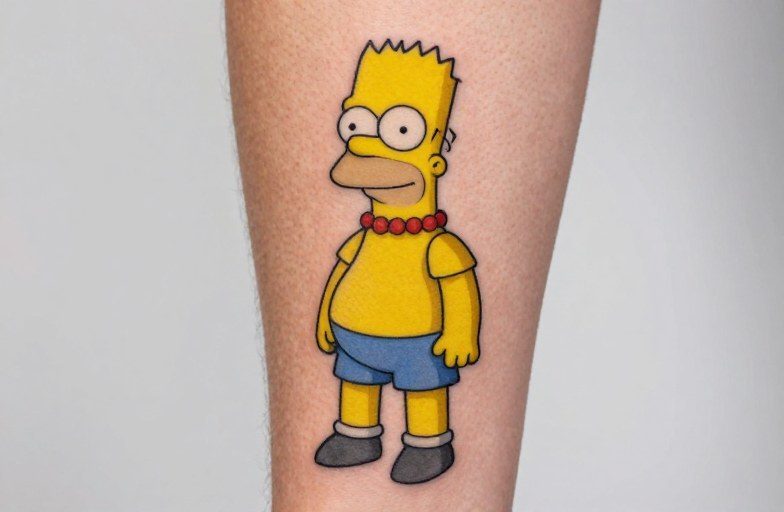
One well-drawn Homer or Bart almost always beats a crowded family portrait. The show’s characters are designed to pop against flat backgrounds; adding Moe’s Tavern or the power plant behind them muddies what makes the image work. If you want multiple characters, consider a “couch gag” format, everyone in a row, same scale, minimal background.
- Pick poses with clear silhouettes: Homer chugging Duff, Bart on his skateboard, Lisa playing sax
- Avoid dialogue-heavy moments; text tattoos age poorly and the font is hard to make legible at small sizes
- Consider the “turnaround”, how the image looks from across the room, not just up close
For First-Timers
Simpsons imagery actually suits first tattoos well because the bold outlines and flat colors are forgiving technically. The show’s palette, yellow, blue, red, green, uses saturated primaries that most artists can mix confidently.
Start Small and Graphic
A three-eyed fish, a pink donut, or Krusty’s face in a 2-3 inch format teaches you how color heals on your skin without committing to a half-sleeve. These icons also hide easily if needed for work. The donut specifically ages beautifully: simple circle, limited colors, no fine lines to blur.
Line Work vs. Color Fill
Black-and-grey Simpsons tattoos can look striking but require an artist who understands how to translate yellow skin into greyscale values. Most opt for color. If you’re nervous about commitment, ask for “line work only” with the option to color later, many artists build pieces this way intentionally.
- Expect 2-3 weeks of visible healing; yellow ink can look muddy during the peeling phase before it settles
- Moisturize aggressively; the show’s large color fields show dry skin more than detailed black work
- Budget for touch-ups; flat color areas sometimes need a second pass
Trending Variations
The “Sad Homer” meme, slumped on a couch, eyes half-lidded, has become a surprisingly popular request for upper arms and calves. It works because the pose is emotionally readable even to people who don’t know the show, and the slumped posture fits naturally over muscle curves.
Neo-Traditional and Japanese Fusion
Some artists are rendering Simpsons characters through other tattoo vocabularies: Homer as a Hannya mask, Bart as a floating wind god, Marge’s hair as a wave crest. These require artists who genuinely understand both the source material and the traditional style they’re blending. Portfolio-checking is essential here, don’t be someone’s first fusion experiment.
Minimalist and Single-Line
A single continuous line forming Homer’s silhouette, or Marge’s beehive reduced to three curves, appeals to people who want the reference without the cartoon brightness. These age differently than bold traditional pieces: fine lines soften faster, but the simplicity means they blur into pleasant abstraction rather than messy confusion.
- “Steamed Hams” sequence: increasingly popular for thigh pieces with narrative panels
- “Do it for her” sign: text-plus-image combo that works on ribs or forearms
- Treehouse of Horror variants: more horror-tattoo friendly, easier to place in mixed-style collections
Color Choices
The canonical Simpsons yellow (Pantone 116 C-adjacent in ink mixing terms) is achievable but tricky. Too bright and it looks neon; too muted and it reads as sickly. Experienced artists often add a touch of orange to ground it, or shift slightly toward goldenrod for better skin-tone contrast.
Background Strategies
Blue Marge hair against no background works. Blue Marge hair against a purple sky fights for attention. Most successful Simpsons pieces use either:
- No background at all, character floating on skin
- Simple flat color fields, clouds, the pink Simpsons sky, green grass
- Blackout backgrounds, dramatic but limits future options around the piece
White highlights (the catchlights in eyes, donut sprinkles) are typically added as negative space or very light grey, not actual white ink, which fades unpredictably.
Best Placements
The roundness of Simpsons characters suits certain body contours naturally. Homer’s belly-heavy form wraps well around calves and outer thighs. Bart’s rectangular stance fits forearms and shins. Marge’s vertical hair draws the eye upward, making her ideal for rib-to-hip placements or the back of an arm.
Size and Detail Thresholds
Below 2 inches, facial features become dots and dashes. The eyes specifically need space to show the signature overbite pupil shape. At 4+ inches, you can include secondary details, Homer’s stubble, the texture of a donut. At 6+ inches, full scenes become possible but require serious commitment to the property.
- Forearm: classic visibility, good for single characters or vertical compositions
- Calf: excellent for horizontal “couch gag” layouts
- Ribs: painful but effective for the “Do it for her” style text-image combos
- Back of upper arm: traditional placement that frames round characters well
Standout Design Ideas
Moving beyond the obvious portraits opens better tattoo territory. The show’s iconography, objects, locations, repeated gags, often makes more interesting skin art than literal character depictions.
Objects and Food
The pink donut with sprinkles is arguably the most tattooed Simpsons image, and for good reason: circular composition, limited palette, immediate recognition. Less common but equally strong: the Flaming Moe, the Krusty Burger, the stonecutter number 908. These read as “in-group” references without requiring a face on your body.
Text and Typography
“D’oh,” “Don’t have a cow, man,” and “Eat my shorts” work as standalone pieces when rendered in the show’s distinctive title font (ITC Kabel, roughly). The chalkboard gag format, repeated lines, Bart’s silhouette, lends itself to custom text substitutions, though the handwriting is harder to nail than most clients expect.
- The Springfield Nuclear Power Plant cooling towers: simple geometric shapes, strong silhouette
- Kang and Kodos in their flying saucer: circular composition, works on knees, shoulders, chest
- The Stonecutters emblem: designed to look like an actual organization logo, ages well
- Homer’s “Mr. Plow” jacket design: period-specific nostalgia, bold color blocking
The Takeaway
Simpsons tattoos succeed when they respect the source material’s graphic strengths: bold outlines, flat color, readable silhouettes, emotional clarity in simple poses. The worst examples try to cram too much narrative into too small a space, or choose references so obscure that the image dies without explanation. Pick something that works as a picture first, a reference second. Bring clean reference. Trust the yellow.
Frequently Asked Questions
How well does Simpsons yellow ink hold up over time?
Yellow ink has a reputation for fading faster than black or red, but the dense, opaque yellow used in Simpsons tattoos typically settles well. Expect some softening after 5-10 years, especially with sun exposure, but the color rarely disappears entirely. A touch-up every few years keeps it bright.
Can I get a realistic-style Simpsons tattoo or should it stay cartoon?
Realistic rendering of cartoon characters almost always looks unsettling, uncanny valley on skin. The most successful “realistic” approaches keep the flat colors but add dimensional shading, like a 3D render of the show’s style. Pure photorealism rarely works with these proportions.
What’s the most commonly requested Simpsons tattoo that artists actually dislike doing?
The full family portrait on a small scale frustrates many artists because clients want six-plus characters with full detail in a space that fits a single palm. The characters blur together, faces become illegible, and everyone leaves disappointed. Artists typically suggest picking one character or a couch-gag horizontal layout instead.
Are there copyright concerns with getting Simpsons characters tattooed?
Tattoo artists operate in a legal gray area regarding copyrighted imagery. Disney (which owns The Simpsons) has not pursued individual tattoo recipients, though some artists avoid posting certain pieces on social media to reduce visibility. For personal, non-commercial skin art, enforcement is virtually nonexistent.