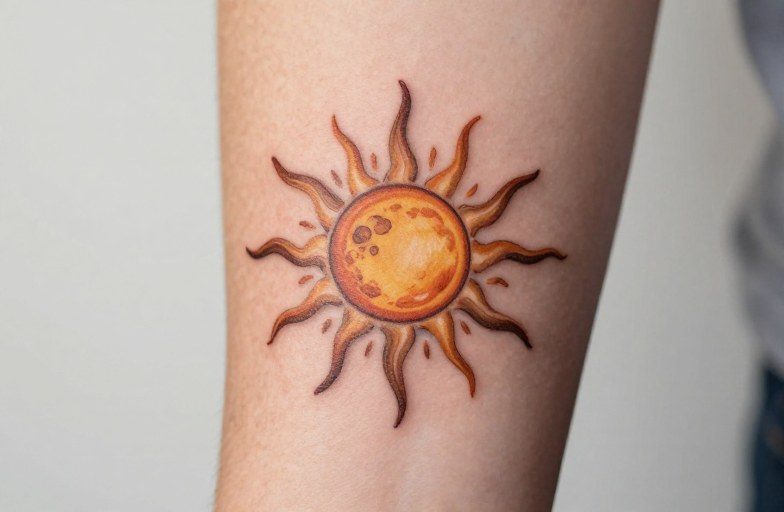
Sunlight tattoos translate something intangible, warmth, energy, the specific slant of morning light through a window, into something permanent on skin. The challenge is that light itself has no solid form. Every successful design solves this problem differently: through radiating lines, negative space, color gradients, or objects that imply illumination without showing the source directly. You might want the literal sun, or you might want what the sun does to the world around it.
Tips for Choosing
Placement Dictates the Shape
A sunburst spreading across a shoulder cap behaves differently than one crawling up a forearm. Rounded areas like the top of the shoulder or knee naturally suit circular, radial designs. Longer, flatter canvases like the side of the ribs or the outer thigh favor horizontal rays, light beams cutting across the skin like they would through blinds. Consider how the tattoo will look when you move. A sunburst on the elbow crease opens and closes with every arm bend, animating the design in a way static placement cannot.
Scale matters with light imagery. Tiny sunlight tattoos often read as generic stars or dots from a distance. The gradient from bright center to fading edge needs enough room to breathe, usually at least palm-sized, to register as light rather than a blob. That said, a single fine-line ray, needle-thin and several inches long, can be strikingly minimal without losing its identity.
Line Work vs. Shading
Pure linework sunlight tattoos rely on consistent, tapering strokes. The best ones vary line weight: thicker where the “source” would be, hairline-thin at the vanishing point. This takes a steady hand and a patient client. Shaded approaches use stippling, whip shading, or smooth gradients to create glow. Stippling holds up longest in small areas but takes forever. Smooth gradients in color look incredible fresh but can muddy as the skin settles and ink spreads slightly over years. Black and gray shading tends to age more predictably than color for light effects, though a skilled color artist can make yellows and oranges sing for a solid decade.
- Linework sunbursts: bold, graphic, age well, limited tonal range
- Stippled glow: textured, organic, time-intensive, excellent for small areas
- Color gradients: immediate impact, requires touch-ups, best on lighter skin tones
- Negative space techniques: use skin tone as the “light,” dark ink as shadow
Color Choices
Working With Yellow and Orange
Yellow tattoo ink has a reputation for fading fast, and it’s partially deserved. Lighter yellows, especially lemon or pale gold, can disappear into skin within a few years. Deeper, more saturated yellows, ochre, mustard, goldenrod, have better staying power. Orange sits in a sweet spot: visible enough to read as warmth, stable enough to last. A common approach layers orange at the core, transitions to yellow at the mid-tones, and lets skin tone handle the brightest highlights.
On darker skin, pure yellow can struggle. Artists often shift toward gold, amber, or even warm white ink mixed with small amounts of yellow to create luminosity without the chalky appearance of straight white. Some effective sunlight tattoos on deep skin tones use no yellow at all, relying on strategic negative space and warm browns or oranges to suggest heat and radiance.
Monochrome and Unexpected Palettes
Black and gray sunlight tattoos subvert expectation in interesting ways. They read as moonlight, eclipse, or memory, less literal, more atmospheric. A single red sunburst carries different connotations: Japanese flag, blood warmth, sunset at its most extreme. Blue sunlight exists in the natural world, think of light through deep water or certain atmospheric effects, and makes for an unexpected but coherent choice. Purple and gold together reference historical art traditions, from Byzantine mosaics to Art Nouveau poster work.
Matching and Pairing Ideas
Objects That Receive Light
Sunlight tattoos pair naturally with objects that receive light rather than generate it. A window frame with rays pouring through. A hand cupped around a beam. A plant angled toward the source. These compositions give the light something to do, a narrative moment rather than abstract decoration.
Consider pairing with:
- Architectural elements: archways, panes of glass, doorways left ajar
- Natural receivers: leaves with visible veins lit from behind, mountain peaks at dawn, ocean horizons
- Figures in silhouette: the human form blocking light creates instant drama
- Time indicators: clocks, hourglasses, sundials, objects that connect light to duration
Designs for Multiple People
Matching tattoos for pairs or groups might split a single sunburst across two bodies, half the rays on one person, half on another, completing the circle when standing together. Alternatively, matching designs could show the same scene at different times: sunrise on one, sunset on another, connected by the same landscape element.
How to Personalize It
Specific Light Events
Generic sunbursts blur together. Specific moments stand apart. The light at a particular latitude and season has a character: Scandinavian summer sun sits low and horizontal, creating long shadows. Tropical noon light comes straight down, harsh and defining. A memory of light through a specific window in a childhood home, with the ray angle matching the actual architecture, carries weight that a stock image cannot.
Some people reference actual astronomical events: a solar eclipse’s corona, the diamond-ring effect, the specific crescent of an annular eclipse. These require technical accuracy to read correctly to those who know, but the payoff is a tattoo that functions as a date stamp, a secret calendar.
Integrating Text or Symbol
Morse code embedded in the rhythm of rays. A constellation visible only in the negative space between beams. A word written in the gradient from light to shadow, legible only when the eye adjusts. These integrations work best when the secondary element doesn’t fight the primary light effect for attention. The sunlight remains the experience; the personal detail rewards closer looking.
Current Directions
Sourceless Light
Contemporary sunlight tattoos have moved away from the tribal-era sun faces and toward more atmospheric treatments. Fine-line rays with no central disc, just parallel lines of varying length, suggest light without depicting its source. This “sourceless light” approach fits the current preference for minimal, ambiguous imagery that works as decoration without demanding narrative interpretation.
Light Leak Aesthetic
Another direction borrows from film photography, where sun hits the camera lens and creates flares, orbs, and color fringing. These translate surprisingly well to tattoo, with organic, non-symmetrical shapes that feel accidental rather than designed. They suit placement along the body’s edges, shoulder to chest, hip to thigh, where the organic flow follows natural contours.
UV-Reactive Ink
UV-reactive ink has seen renewed interest, though with realistic limitations. It genuinely glows under blacklight but looks faint or strange in normal light, and long-term stability remains uncertain. Some artists use it sparingly: a few accent dots in a larger design, not the whole effect. Approach this as a potential bonus feature, not the main event.
Standout Design Ideas
Architectural Light
A corridor or room rendered in perspective, with light entering from an unseen window, creating a visible beam through implied dust particles. This draws on the Dutch Golden Age painting tradition of light as a physical presence. The tattoo becomes a framed scene, a portal on the skin. Works best at larger scale, with enough detail in the architecture to establish the space.
Fragmented Sun
A sun disc broken into geometric shards, each fragment containing a different time of day or season’s light. One piece holds dawn pink, another noon white, another the heavy gold of harvest season. The fragmentation suggests cycles, impermanence, or personal history pieced together. Geometric precision in the breaks contrasts with organic color variation inside.
Living Light
Sunlight as it interacts with living things: the translucent glow of a leaf held up, light through wings or fins, the way skin itself becomes luminous with strong backlighting. These designs often use white ink or negative space for the brightest areas, letting the body’s own tone participate. A hand or face in the design, rendered in shadow, with light defining only the edges, this creates intimacy and scale simultaneously.
Before You Decide
Sunlight tattoos succeed when they solve the problem of depicting something without mass. The best designs choose one approach and commit fully: either the disciplined geometry of linework, the patient texture of stippling, or the risky immediacy of color. They place the work where the body will help it move or breathe. They give the light something to illuminate, a window, a hand, a mountain ridge, rather than letting it float anchorless.
Your skin tone, your pain tolerance for long sessions, your willingness to return for touch-ups: these practical factors shape what is possible more than any Pinterest board. Talk through the aging process with your artist. Ask to see healed photos of their light work, not just fresh. The glow you want is the one that remains after the redness fades and the swelling subsides, when the tattoo has to speak on its own.
Frequently Asked Questions
How well do yellow and orange inks hold up in sunlight tattoos?
Deeper yellows like ochre and goldenrod last longer than pale lemon shades. Orange is generally more stable than yellow. Black and gray typically age most predictably for light effects, though skilled color artists can make warm tones last a decade with proper care.
Can sunlight tattoos work on darker skin tones?
Yes, but the approach often shifts. Pure yellow can struggle, so many artists use gold, amber, warm white mixed with yellow, or skip yellow entirely in favor of negative space and warm browns or oranges to suggest radiance.
What is the best placement for a sunlight tattoo?
Rounded areas like shoulders suit radial designs; flat canvases like ribs favor horizontal beams. Consider movement: an elbow crease sunburst animates with every bend. Most light imagery needs at least palm-sized scale to read clearly.
What does ‘sourceless light’ mean in tattoo design?
It refers to fine-line rays with no central sun disc, just parallel lines suggesting light without depicting its origin. This minimal approach has become popular for its ambiguity and decorative flexibility.