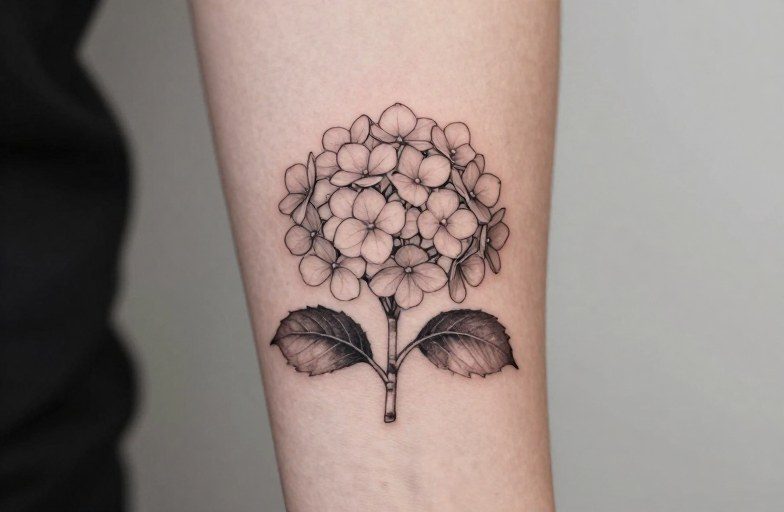
A hydrangea in full bloom carries serious visual weight, dense clusters, ruffled petals, layered color shifts. Strip that down to minimalist essentials and the challenge gets interesting. You’re preserving the flower’s recognizable silhouette without letting the detail overwhelm the skin. Done right, the result feels light, intentional, and distinctly botanical rather than generic floral.
Color Choices
Minimalist work doesn’t mean black ink only. Hydrangeas offer a rare color flexibility in nature, soil pH actually shifts their petals from deep blue to soft pink to creamy white. That biological quirk gives you real options for a restrained palette.
Single-Tone Approaches
One color family keeps the minimalist promise intact. A muted slate blue, dusty rose, or warm ivory can carry the whole piece. Watercolor-style washes work here if kept tight, no bleeding gradients across three inches of skin. The wash should stay within a defined petal outline, almost like a coloring book page with one fill color.
Black and grey offers the most longevity. A single needle or tight three-liner can render individual florets as tiny circles clustered into a soft dome. Over time, black greywash settles into the skin more predictably than most color pigments. Blues and purples, especially lighter values, tend to fade faster and can shift toward muddy tones as they age.
Accent Color Strategy
Some designs use near-total black linework with one strategic color hit, a single blue petal, a pale pink center, a green stem stroke. This draws the eye without cluttering the composition. The restraint matters more than the hue choice. One accent beats three competing colors in small-scale work.
Size & Scale
Hydrangea’s natural structure, many small flowers forming one head, demands careful scaling. Too small and the florets blur into a blob. Too large and the minimalist intention dissolves into botanical illustration.
Minimum Effective Size
On most skin, a hydrangea head needs at least two inches in diameter to read clearly. Below that, the individual florets lose definition and the piece starts looking like an abstract cloud. Finger placements, side-of-hand spots, or tiny behind-the-ear designs rarely succeed with this specific flower. The exception: a single floret detached from the cluster, rendered as one small four-petaled shape with minimal center detail.
Placement Logic
- Inner forearm: Flat surface, good light exposure, easy to scale around two to three inches. The natural curve of the muscle can follow the dome shape of the flower head.
- Ribcage side: Vertical space suits a stemmed hydrangea with negative space above and below. Skin here moves with breathing, so extremely fine linework may blur over years.
- Upper shoulder/clavicle: Bone proximity means sharper tattooing but potential discomfort. The rounded cap of the shoulder echoes the flower’s natural dome.
- Ankle or calf: Lower leg skin holds ink well. A small cluster with short stem works here, though calf placement competes with sock lines and seasonal coverage.
Trending Variations
Current minimalist hydrangea work splits into a few recognizable approaches, each with different technical demands and aging profiles.
Botanical Line Work
Single-needle or very tight liner work maps each floret as a small circle with a tiny center dot, dozens clustered into the familiar dome. No shading, no fill. The skin itself becomes the “white” of the petals. This ages fastest where lines crowd together, expect some softening at the cluster’s densest center after five to eight years. Touch-ups are straightforward.
Negative Space Petals
The flower head becomes a solid silhouette with small cutouts, negative space, where individual florets would sit. This reads as hydrangea from a distance, abstract shape up close. Requires confident, even fill shading or solid black packing. Healing on larger solid areas tends to be itchier and needs disciplined aftercare to avoid scabbing that pulls ink.
Stem-Heavy Compositions
A long, slender stem with minimal leaves and one reduced flower head at top. The vertical format suits rib placements, spine-adjacent spots, or the outer forearm. Proportion matters: the stem should feel deliberate, not an afterthought. Too thin and it looks like a wire; too thick and it dominates the flower.
How to Personalize It
Minimalist doesn’t mean identical. The flower’s cultural associations, often linked to gratitude, abundance, or sometimes heartfelt emotion in different traditions, give starting points, but the personalization should be visual and specific.
Consider birth month tie-ins: hydrangea covers June and July in some floral calendars. A number of petals matching a date, or a small initial tucked into the cluster’s edge where it doesn’t disrupt the silhouette. Some people integrate a handwriting sample, a parent’s script, a partner’s, into the stem as if it were a natural growth line. The stem’s linear nature accepts this better than the flower head.
Pairing with another element needs restraint. A single bee, a tiny snail, a crescent moon positioned near but not overlapping the bloom. The companion should be smaller in visual weight or the balance tips toward busy illustration.
Tips for Choosing
Finding an artist for this specific subject means looking past general floral portfolios. Hydrangea structure is unforgiving, get the cluster wrong and it reads as generic puffball.
What to Review in Portfolios
- Look for healed photos, not just fresh work. Fresh minimalist tattoos always look crisper; the healed reality shows whether the artist’s line weight and spacing hold up.
- Check for botanical accuracy in other flower work. Roses and peonies are common; hydrangea specifically is rarer. An artist who understands how florets group versus how petals layer on a rose will translate that structural thinking.
- Ask about needle grouping preference. Single-needle specialists produce different results than artists who default to three-liner or magnum shaders. Neither is wrong, but the texture differs significantly.
Consultation Red Flags
Be wary of artists who suggest heavy black outlining “to make it pop”, that’s a different aesthetic. Minimalist hydrangea relies on subtle value shifts or pure line confidence. Also question any promise that color will stay exactly as mixed; all tattoo pigment shifts, and hydrangea-relevant blues and violets are among the less stable families.
Standout Design Ideas
Specific compositions that move beyond the obvious:
A half-dome emerging from behind the ear, stem trailing down the neck’s edge, rendered in three shades of blue-grey that shift subtly from top to bottom. The partial view suggests a larger plant without requiring full rendering.
Two tiny florets separated by an inch of skin, connected by a whisper-thin stem line that curves with the inner arm’s natural hollow. The gap becomes part of the design.
A single large leaf in solid black, with a small cluster of florets emerging from its base, flipping the usual hierarchy where flower dominates. The leaf’s veining, done with three parallel lines, provides texture without ornament.
Pressed-flower style: the hydrangea head flattened into a two-dimensional oval, with individual florets as simple circles in a grid-like pattern, stem extending straight down. Reads as botanical specimen, not romantic bouquet.
Before You Decide
Live with the sketch on paper for a week. Hydrangea’s rounded, generous shape can feel very different on skin than in concept, sometimes too soft, sometimes unexpectedly heavy. The minimalist version especially risks reading as “unfinished” to viewers unfamiliar with the intention, or as “just a flower” to those who don’t recognize the specific species. That’s not necessarily a problem, but it should be a conscious choice.
Consider seasonal timing. If you’re planning color work, healed results show truest after the summer tan fades. Fresh tattoos also heal more comfortably in moderate temperatures, less sweat migration into healing skin, less sun exposure temptation.
Finally, the stem question: include one or go stemless? A floating flower head feels modern, almost graphic-design influenced. A stemmed version grounds the image in botanical reality. Neither is superior, but the choice significantly shifts the tattoo’s character. Decide before you walk into the shop, not during the stencil phase.
Frequently Asked Questions
Do minimalist hydrangea tattoos age badly because of the small details?
They can soften over time, especially single-needle cluster work. The key is keeping enough space between florets so they don’t blur together. Black and grey ages more predictably than light blues or pinks, which tend to fade faster.
Can a minimalist hydrangea work as a cover-up or near other tattoos?
Minimalist hydrangea needs negative space to read correctly, so it’s poor for covering dark existing work. As a companion piece, it works best near similarly light, airy designs, heavy blackwork nearby makes it disappear visually.
Why do some hydrangea tattoos look like generic flowers while others read instantly as hydrangea?
The floret cluster structure is the giveaway. Hydrangea has dozens of tiny four-petaled flowers forming a dome, not large layered petals like a rose. Artists who simplify that dome shape too much lose the species-specific recognition.
Is there a meaning difference between blue and pink hydrangea tattoos?
Some traditions associate blue with apology or understanding and pink with genuine emotion, though these connections vary culturally. Most people today choose based on aesthetic preference or personal color memory rather than fixed symbolism.